


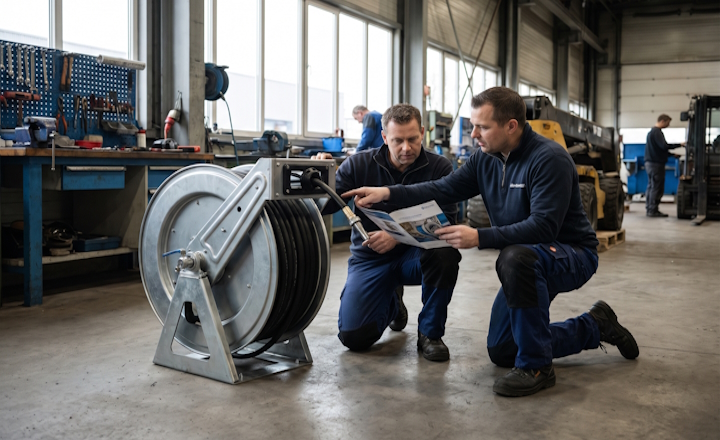
A retractable hose reel helps workplaces store and access a hose without leaving loose lengths across floors or work areas. In workshops, washdown bays and service areas, a suitable reel can make routine tasks easier to organise and reduce the need to coil a hose by hand after each use. The right choice depends on the job the hose performs, how often it is used and the conditions around the installation.
Businesses comparing hose reels should start with the practical requirements of the task. Consider the hose’s length and diameter, the substance it carries, its working pressure and temperature, and the distance between the reel and the point of use. These details determine the capacity and construction needed. Reel Tech provides hose and cable reel solutions for industrial applications, so it is useful to define the job clearly before choosing a product.
Match the reel to the hose
The reel must accommodate the hose’s full length and weight without forcing it into a tight bend. Check the manufacturer’s capacity information and confirm that the hose’s bend radius is suitable for the drum. If the hose is too large or heavy for the reel, winding may be difficult and the assembly may wear more quickly. A smaller hose used for occasional workshop tasks will not place the same demands on a reel as a long hose used for regular industrial washdown. For a retractable hose reel, capacity and bend radius are two of the first specifications to confirm.
Also confirm compatibility with the material being transferred. Air, water, oils, chemicals and other media can require different hose specifications, and the reel must be suitable for the intended operating pressure and temperature. Do not rely on a general product description alone; check the product documentation and discuss unusual operating conditions with the supplier.
Consider materials and the work environment
The installation environment should guide material selection. Steel construction can provide strength for demanding applications, while protective finishes may help in areas exposed to moisture. Stainless steel can be appropriate where corrosion resistance or regular cleaning is important. Aluminium may be useful when equipment weight is a concern. The best option depends on the exposure expected at the site, including water, chemicals, dust, outdoor weather and possible impact. Suitable hose reels should be selected with both the environment and the hose material in mind.
Think about the way the equipment will be used throughout a shift. A fixed reel in a washdown area may need different protection from one installed on mobile machinery. Leave enough room for the reel to rotate and for the hose to travel along its intended path. The mounting structure must support the assembly, and the selected position should allow operators to reach controls without stretching or twisting into an awkward posture. A retractable hose reel installed outdoors should be selected for the actual exposure and mounting conditions.
Select an appropriate rewind mechanism
Manual rewind can suit some low-frequency or lighter-duty applications. Spring rewind allows a hose to retract after use, while air, electric or hydraulic drive systems may be appropriate for particular industrial duties. The choice depends on the hose’s size and weight, how frequently it is deployed, the available power source and the level of control needed during retrieval. A retractable hose reel is especially useful when the hose needs to be returned to storage after regular use.
Before choosing a mechanism, consider how operators will pull out and return the hose. The reel should be positioned so the hose does not scrape against sharp edges or cross busy walkways. Depending on the model, accessories such as hose guides or locking features may help with handling. Confirm which features are included rather than assuming every reel uses the same design.
Make safe handling part of the plan
Organised hose storage can help reduce trip hazards, but it does not replace safe operating procedures. Staff should know how to release, use and retract the hose according to the manufacturer’s instructions. Keep hands clear of moving parts and avoid allowing a hose to retract uncontrolled. The reel should be installed securely, and any locking or rewind-control features should be used as intended. Include the retractable hose reel in the site’s scheduled equipment checks.
Inspect the hose and reel regularly. Look for cracks, leaks, corrosion, loose fixings, damaged couplings and changes in the rewind action. A reel that makes unusual noises or no longer operates consistently should be assessed before further use. Inspection frequency should reflect how often the equipment is used and the severity of its working conditions.
Compare options against the actual task
When comparing equipment, look beyond the product name and confirm the specifications that matter for the application. Check hose capacity, operating limits, material compatibility, mounting requirements, rewind style and the availability of suitable accessories. Compare hose reels by the same technical criteria so differences in capacity and operation are clear.
Reel Tech supports industrial hose and cable handling requirements with standard and customised reel solutions. Providing clear information about the hose and its use can help narrow the options to products that fit the work. A considered selection should make storage practical, allow controlled access and fit into the site’s maintenance procedures without adding unnecessary complexity. For businesses comparing hose reels, the intended task should guide the final choice. Correctly specified hose reels can make routine storage and access more manageable.
| < Prev | Next > |
|---|