
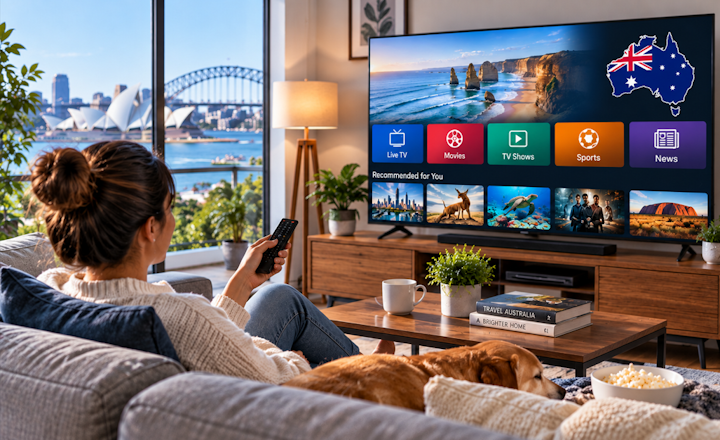
The way Australians watch television has changed considerably. Online streaming has become an important part of everyday entertainment, with ACMA research showing that 91% of Australian adults watched video through an online service during a typical week in 2025.
Alongside established streaming platforms, IPTV has also become increasingly popular. But one question frequently comes up: Is IPTV legal in Australia?
The short answer is that IPTV itself is a technology for delivering television and video content over the internet. The important consideration is whether the provider has the appropriate rights or permissions to distribute the content it offers.
What Is IPTV?
IPTV stands for Internet Protocol Television. Instead of receiving television programming through traditional terrestrial, satellite, or cable broadcasting, IPTV delivers audiovisual content through an internet connection.
An IPTV service may offer different types of programming, including:
- Live television channels- On-demand movies
- Television series
- Catch-up programming
- Electronic Program Guides (EPG)
- News and entertainment content
- Other online video programming
The technology itself is not inherently illegal. The key issue is the source of the content and whether the provider is authorised to distribute it.
Is IPTV Legal in Australia?
Using IPTV as a technology is not automatically illegal.
Australian copyright law gives copyright owners exclusive rights over certain uses of their works, including communicating copyright material to the public. Generally, using protected material in a way covered by those exclusive rights requires permission from the copyright owner unless an exception or statutory licence applies.
Therefore, a legitimate IPTV provider should have the necessary permissions, licences, agreements, or other legal basis to distribute the channels and programs included in its service.
This distinction is important because two IPTV services can use exactly the same technology while having completely different legal positions.
What Makes an IPTV Service Legal?
When evaluating an IPTV provider in Australia, there are several factors worth considering.
1. Content Licensing
The most important consideration is content licensing.
A legitimate provider should have the appropriate rights to offer the television channels, movies, series, or other copyrighted material included in its service.
Consumers should be cautious about services that advertise premium content without providing any meaningful information about where their programming comes from.
2. Transparent Business Information
A professional IPTV provider should make it reasonably clear who operates the service and how customers can contact the business.
Look for information such as:
- Company or business information- Contact details
- Terms and conditions
- Privacy information
- Refund or cancellation policies
- Clear subscription information
A lack of basic business information can be a warning sign.
3. Clear Subscription Terms
Legal streaming services normally explain what customers are purchasing.
Before subscribing, check the subscription period, pricing, renewal conditions, supported devices, and cancellation rules.
Avoid providers that make unrealistic promises or pressure customers into paying immediately without explaining the service properly.
4. Appropriate Content Claims
Be careful with IPTV advertisements promising thousands of premium channels for an unusually low price.
A very large channel list does not necessarily indicate a better service. More importantly, consumers should consider whether the provider can legitimately offer all of the advertised content.
The Australian Attorney-General's Department explains that copyright owners can license their rights to others, meaning authorised distribution arrangements are an important part of legitimate content delivery.
Legal IPTV vs Unauthorised IPTV
The difference can be easier to understand when comparing typical characteristics.
| Legal IPTV Service | Potentially Unauthorised Service |
|---|---|
| Provides information about the business | Limited or unclear business information |
| Explains subscription terms | Vague subscription conditions |
| Content is properly authorised | Unclear source of content |
| Provides customer support | Limited or anonymous support |
| Has clear policies | Few or no legal/business policies |
| Makes realistic claims | Unrealistic channel promises |
| Uses legitimate distribution arrangements | May redistribute copyrighted content without permission |
These characteristics are not by themselves a legal determination, but they can help consumers make more informed decisions.
Why Content Rights Matter
Imagine an IPTV provider offering access to a premium television channel.
The fact that the provider can technically stream that channel does not automatically mean it has the right to redistribute it.
Copyright law is concerned with the rights attached to protected content. The Australian Government explains that copyright can generally be licensed, assigned, or otherwise dealt with by copyright owners.
Consequently, a legitimate IPTV business needs to consider the rights associated with the content it makes available.
What About Free IPTV Services?
Free does not automatically mean illegal.
There are many legitimate ways to watch television and video content online without paying a traditional subscription. Some broadcasters and content providers make selected programs available for free through their own websites or applications.
The important question is not simply whether the service is free or paid. Instead, consumers should consider whether the service is authorised to distribute the content.
What Should Australians Check Before Subscribing?
Before purchasing an IPTV subscription, take a few minutes to investigate the provider.
Check the Website
A professional website should clearly explain the service, pricing, supported devices, and customer support options.
Review the Terms
Read the terms and conditions before paying. Pay particular attention to subscription duration, automatic renewal, cancellation, and refunds.
Look for Business Details
Check whether the provider clearly identifies the business responsible for the service.
Consider the Content
If a service promises virtually every premium channel, international sports event, movie, and television network at an extremely low price, it is worth asking how those rights are obtained.
Avoid Suspicious Payment Requests
Be cautious if a provider insists on unusual payment methods or asks customers to send money through channels that provide little consumer protection.
IPTV and the Australian Streaming Market
The popularity of online video demonstrates that Australian viewing habits are continuing to evolve. ACMA reported that paid subscription streaming services such as Netflix, Stan and Binge were used by 68% of Australian adults in 2025.
Australia's regulatory environment is also evolving. In 2026, new Australian content requirements came into effect for certain large subscription video-on-demand services. The ACMA is responsible for overseeing compliance with those requirements.
These developments highlight the increasingly important role that internet-based television and streaming services play in Australia's media landscape.
Is IPTV the Same as Netflix or Stan?
Not necessarily.
IPTV describes a method of delivering television content over an IP network. Netflix, Stan, Binge and similar platforms are specific streaming services with their own content catalogues, applications, licensing arrangements, and business models.
An IPTV service can therefore have a very different structure from a conventional subscription streaming platform.
The technology used to deliver content does not, on its own, determine whether the service is legal.
How to Find Legal IPTV in Australia
If you are looking for a legitimate IPTV service, focus on transparency rather than simply searching for the largest channel list.
A trustworthy provider should be able to explain:
- What its service provides- Which devices are supported
- How subscriptions work
- How customers receive technical support
- What terms apply to the service
- How the provider obtains or distributes its content
The more transparent the provider is, the easier it is for customers to make an informed decision.
Final Thoughts
IPTV is an internet-based method of delivering television content, and the technology itself should not automatically be confused with copyright infringement.
The crucial issue is content rights.
For Australian consumers, choosing a legitimate IPTV service means looking beyond price and channel numbers. Check the provider's business information, subscription terms, customer support, and—most importantly—the legitimacy of the content being offered.
A responsible approach to IPTV is simple: choose transparent providers and services that have the appropriate rights to distribute their content.
This article is intended for general informational purposes and does not constitute legal advice. Copyright and media regulations can change, so consumers with specific legal questions should consult an appropriately qualified Australian legal professional.