
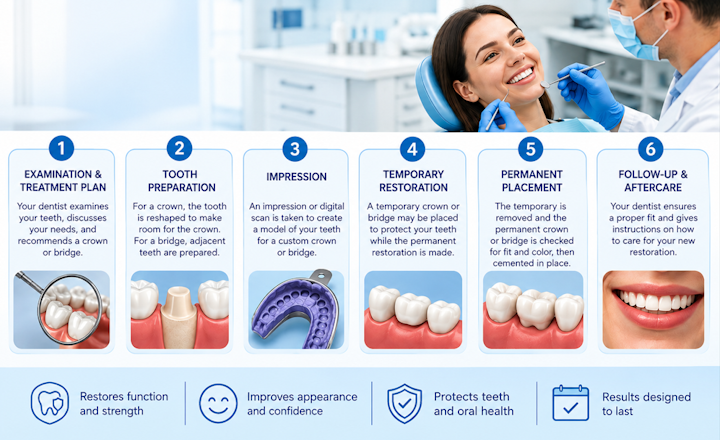
Being told you need a crown or bridge often raises the same practical questions — how many appointments will this take, what's actually involved at each step, and what should you expect afterward? Both fall under the broader category of general treatments most dental practices offer. Here's a general overview of the process for both.
Getting a Dental Crown: The General Process
Assessment and planning — Your dentist examines the tooth, potentially takes an x-ray, and determines whether a crown is the appropriate treatment based on the extent of damage or decay.
Tooth preparation — A portion of the tooth's outer structure is removed to make room for the crown, ensuring it fits naturally alongside neighbouring teeth.
Impressions or digital scanning — A precise mould or scan of the prepared tooth is taken, used to fabricate a crown that fits your bite accurately.
Temporary crown — While the permanent crown is being made, a temporary is generally fitted to protect the prepared tooth in the meantime.
Fabrication — Depending on the practice and material, this may take one to two weeks via an external laboratory, or in some cases be completed on the same day using in-house milling technology.
Fitting the permanent crown — Once ready, the crown is checked for fit and appearance, adjusted if needed, and then permanently cemented into place.
Getting a Dental Bridge: The General Process
Assessment and planning — Your dentist assesses the health of the teeth adjacent to the gap left by the missing tooth, confirming they're suitable to support the bridge.
Preparing the supporting teeth — The adjacent teeth are shaped down, similar to preparing a tooth for a crown, since they'll each need a crown to anchor the bridge.
Impressions or scanning — A mould or scan captures the prepared teeth and the gap between them, used to fabricate the bridge as a single connected structure.
Temporary bridge — A temporary is generally fitted to protect the prepared teeth and maintain appearance and function while the permanent bridge is made.
Fitting the permanent bridge — Once fabricated, the bridge is checked for fit and bite, adjusted as needed, and then permanently cemented into place across the supporting teeth.
What to Expect After Either Procedure
Some mild sensitivity to hot or cold is common in the days following placement of a crown or bridge, generally settling as you adjust. It can take a short period to get used to the slightly different feel when biting or speaking, which is typically temporary. If discomfort persists or your bite feels distinctly uneven, this is worth reporting to your dentist.
Caring for a Crown or Bridge Long-Term
Both require consistent oral hygiene, since the margins where the restoration meets natural tooth structure remain susceptible to decay. For bridges specifically, cleaning underneath the replacement tooth is important, often requiring tools like floss threaders or interdental brushes designed for this purpose. Regular check-ups allow your dentist to monitor the restoration and surrounding teeth over time.
What Influences How Long Each Option Lasts
Longevity for both crowns and bridges depends on factors including oral hygiene, bite forces, whether you grind your teeth, and the health of the supporting tooth structure. Neither is indefinitely permanent, and individual outcomes vary based on these factors and regular maintenance.
Getting Started
If your dentist has recommended a crown or bridge, it's worth asking them to walk through the specific steps relevant to your case, including expected timeline and cost. The most reliable way to understand what your own treatment will involve is a clinical assessment by an AHPRA-registered dental practitioner.