
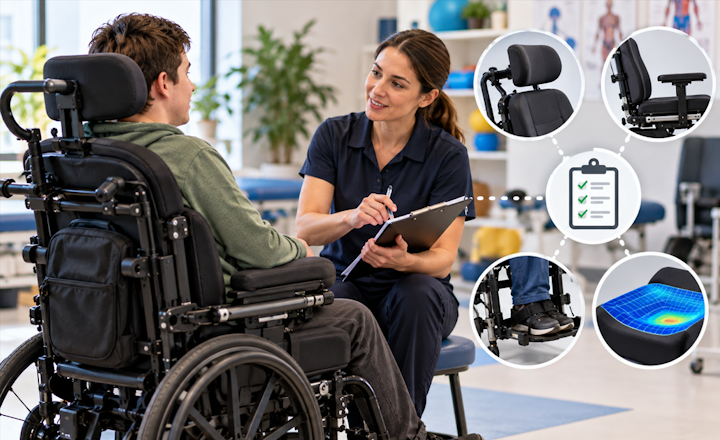
Ask any occupational therapist who has spent an afternoon wrestling with a funding request for a custom seating system, and they will tell you the hardest part isn't choosing cushions. It's proving, in plain clinical language, why an off the shelf chair won't cut it for someone with asymmetrical tone, a windswept hip pattern, or skin that breaks down after twenty minutes upright. Complex seating assessments sit right at that pressure point, where clinical judgement, paperwork, and a person's actual daily life all have to line up neatly on one form.
If you're newer to this corner of practice, or you just want a gut check before your next home visit, here's a working checklist built from what commonly trips people up in the field, not just what the textbooks promise.
Start with posture in three positions, not one
A seat that looks fine in a clinic chair for twenty minutes can fall apart by dinner time. That's why a proper complex assessment looks at posture lying down, sitting up, and standing (or supported standing, where relevant), because gravity pulls on the body differently in each. Skipping the lying assessment is a classic shortcut, and it's usually the one that comes back to bite everyone once a pressure injury shows up six months later. A full postural picture, sometimes called a mat assessment, gives you the baseline flexibility and asymmetry data that everything else in the report hangs off.
Plus, this is the part that actually justifies the equipment choice later. Funding bodies don't want a description of a wheelchair, they want a reason the wheelchair has to look like that for this particular body.
Pressure mapping earns its keep here
Pressure mapping sounds like a nice-to-have until you've watched someone's numbers spike the moment they lean forward to reach a cup. It turns a hunch about redistribution into a picture you can literally point at in a case conference. For clients with any history of skin breakdown, spinal cord injury, or reduced sensation, treat mapping as close to non-negotiable rather than an optional extra you'll get to if there's time.
Trial before you write it down
Here's the thing nobody enjoys admitting: a lot of seating write ups are based on catalogue photos rather than a genuine trial. But here's the catch, complex clients rarely tolerate a system the same way in week one as they do in week four. Where possible, get a loan chair or demo seating component into the home or school for a proper stretch of time, not just an afternoon. Sweaty backs, sliding pelvises, and carer frustration all show up with time, not in a single fitting session.
So what's the practical fix? Build trial periods into your assessment timeline from the start, and say so explicitly in your report. Assessors reading NDIS applications like seeing that a clinician actually watched the equipment work in the client's real environment, not just in a showroom.
Bring the carer into the room, literally
A seating system that's brilliant for the client but impossible for a carer to transfer, clean, or adjust is a system that ends up abandoned in a hallway within a year. Ask carers to physically demonstrate transfers during your assessment, not just describe them. You'll often catch problems this way that neither party thought to mention, like a headrest that blocks a hoist sling or armrests that can't be removed one handed.
Documentation that survives scrutiny
NDIS reports live or die on whether they connect the dots between impairment, function, and goals. Vague phrases like improved comfort or better positioning get bounced back for more information almost every time. Instead, tie each recommended feature to a specific functional outcome: tilt in space for pressure relief and fatigue management during a school day, a headrest for safe transport, elevating leg rests for oedema management post surgery. Reasonable and necessary isn't a vibe, it's a paper trail.
If you're assessing for a client who needs modular components such as tilt in space bases, contoured cushions, or head positioning hardware, it helps to know the breadth of what's actually available before you write a justification around a single product. GTK's seating and positioning range gives a decent snapshot of current Australian options, which is useful context when a planner asks why you specified one brand over another.
The checklist, condensed
Before you sign off on a complex seating assessment, run through this: posture assessed lying, sitting, and standing. Pressure mapping completed where clinically indicated. A genuine equipment trial, not a single fitting. Carer transfer and maintenance tasks demonstrated in person. Every recommended feature tied to a named functional goal. And a plan for review, because bodies change and so should seating.
Bottom line, complex seating work is slow, a little unglamorous, and easy to rush when your caseload is stacked. But the clients who need this equipment most are usually the ones with the least room for error if it goes wrong. A thorough assessment now saves everyone a painful, expensive redo later, and that's reason enough to slow down and do it properly.
A note on timing and reassessment
One thing that catches out even experienced clinicians is treating a seating assessment as a single, finished event. Bodies with progressive or fluctuating conditions don't sit still, literally or figuratively. Tone can change with medication adjustments, weight shifts after a growth spurt or illness, and skin integrity can shift with seasons, mobility levels, or general health. Building a review date into your report, even a rough twelve month marker, gives everyone a natural checkpoint rather than waiting for a crisis, like a pressure sore or a chair that's suddenly too small, to force the issue.
Plus, a scheduled review tends to be a much calmer conversation than an urgent one. Nobody makes their best clinical decisions while also managing an open wound or a client stuck in a chair that no longer fits properly. If you can, flag likely trigger points in your original report too, things like an upcoming surgery, a school transition, or a known progressive diagnosis, so future clinicians reading the file understand why a review might land sooner than the standard timeframe.
Working with the wider team
Complex seating rarely sits with one clinician alone. Physiotherapists often bring detailed range of motion and tone data, speech pathologists may flag positioning needs for safe swallowing, and support coordinators usually understand the funding mechanics better than anyone else in the room. Loop these people in early rather than writing your report in isolation and hoping it lines up with what everyone else has said. A seating recommendation that contradicts a physio's tone management plan, or ignores a swallowing safe position noted by speech pathology, tends to get picked apart during plan review, and rightly so.
Truth is, the strongest reports read like a team actually talked to each other, because inconsistencies between disciplines are one of the fastest ways a request gets sent back for clarification. A quick phone call before you finalise your write up is usually faster than the delay caused by skipping it.