
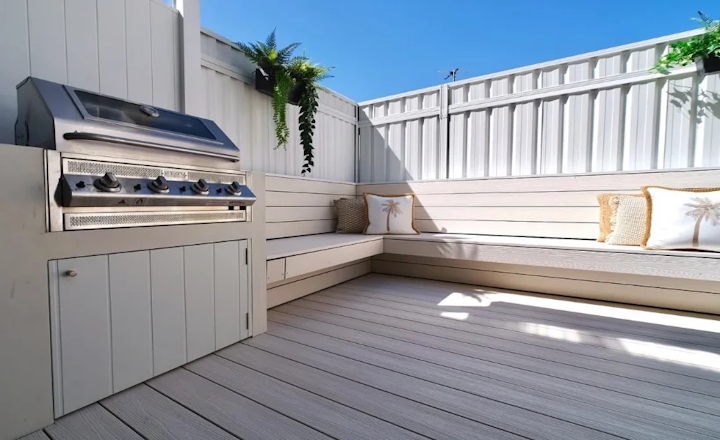
Whether you are looking to boost your property value or create a modern sanctuary for family barbecues, upgrading your outdoor living space is a game-changer. Two of the most popular options for Australian homeowners are patios and composite decking.
Both options enhance curb appeal and offer a seamless transition between indoor and outdoor living. However, they differ significantly in material, installation, and long-term maintenance.
If you are at a crossroads, this guide compares the key differences, pros, and cons to help you make an informed decision for your home.
What Is A Patio?
A patio is a ground-level, paved outdoor area. Unlike raised decks, patios are built directly on the soil or a compacted base. They are constructed from solid masonry materials such as concrete, pavers, brick, stone, or tiles.
Best For: Contemporary, minimalist landscapes on flat terrain.
Installation & Longevity:
Building a patio typically requires excavation, levelling, and the creation of drainage layers to ensure a stable base. While labour-intensive to install, they are incredibly durable.
Concrete & Pavers: Can last 50+ years.
Natural Stone (Granite, Travertine, Bluestone): Can last up to 100 years.
Maintenance:
Patios are low maintenance but not "no maintenance." They may require weed control between pavers, occasional pressure washing, and resealing to prevent staining or weather damage.
What Is Composite Decking?
Composite decking is the modern, sustainable alternative to traditional timber. It is manufactured from a blend of recycled wood fibres, plastics, and bonding agents to create boards that mimic the warmth and look of natural wood without the hassle.
Best For: Homes with children or pets, uneven terrain, and eco-conscious buyers.
Resilience & Lifestyle:
Composite boards are engineered to resist rotting, moisture, fading, pests (like termites), and splintering. This makes them safer for bare feet and paws.
Maintenance:
Unlike timber, composite decking never needs sanding, oiling, or varnishing. A simple wash once or twice a month is all that is required to keep it looking pristine.
Key Differences: Patio vs. Composite Decking
To choose the best setup for your lifestyle, it is essential to understand how these two options differ structurally and functionally.
1. Terrain and Assembly
Composite Decking: Installed on a subframe (timber, steel, or aluminium) by Australian deck suppliers, which allows it to be raised, making it the perfect solution for sloped blocks, uneven ground, or second-story balconies.
Patios: Require a flat, stable foundation. They involve excavation and compacting, making them best suited for level backyards.
2. Durability and Lifespan
Composite Decking: A lifespan of approx. 25–50 years. It is highly resistant to moisture and rot but doesn't have the century-long lifespan of stone.
Patios: A lifespan of 50–100 years. However, without a proper base, ground movement can cause pavers or concrete to crack over time.
3. Moisture Resistance
Composite Decking: Low water absorption rates prevent warping and swelling. It is ideal for pool decks and wet climates.
Patios: Generally water-resistant, though porous stones can absorb water. In colder climates, trapped water can freeze and cause cracks.
The Pros and Cons
Composite Decking
The Benefits:
Versatile Installation: Can be built over uneven ground or existing concrete.
Zero Fading: UV-resistant caps preserve the colour for decades.
Eco-Friendly: Often made from 100% recycled materials.
Safety: Non-slip surface options are excellent for pool areas.
-
Pest Proof: Insects cannot burrow into the composite material.
The Drawbacks:
Weight Limits: Not ideal for extremely heavy loads (like large spas) without reinforced structural support.
Heat: Darker boards can get hot under the direct summer sun.
Permits: Local council approval is often required for raised structures.
Patios
The Benefits:
Load Bearing: excellent for heavy fixtures like stone pizza ovens, large outdoor fireplaces, or parking vehicles.
Design Variety: Endless patterns available using bricks, slate, or stamped concrete.
Extreme Longevity: High-quality stone can outlast the house itself.
Privacy: Being ground-level usually offers more privacy from neighbours compared to elevated Sydney decking solutions.
The Drawbacks:
Terrain Limits: Not suitable for sloped blocks without expensive retaining walls.
Cracking Risks: Tree roots and ground shifting can disturb the pavers.
Hardness: Hard surface is less forgiving underfoot compared to timber or composite.
Final Verdict: Which Is Right For You?
When making your final decision, consider these four factors:
1. Location: Do you have a sloped block or a flat yard? Use decking for slopes and patios for flat ground.
2. Purpose: Are you parking a car or installing a heavy fountain? Choose a patio. Do you want a seamless indoor-outdoor flow for a living room extension? Choose decking.
3. Budget & Timeline: Patios often cost less in materials but more in labour (excavation). Decking costs more in materials but is faster to install.
Aesthetics: Do you prefer the warm, textured look of timber (decking) or the cool, solid look of masonry (patio)?
The Bottom Line
Both options add significant value and functionality to your home. If you want a "set and forget" timber look, go with composite decking. If you want a permanent, heavy-duty masonry structure, choose a patio.
Ready to transform your outdoor space? We recommend consulting with a local builder or landscape designer to assess your site’s specific needs.
| < Prev | Next > |
|---|