
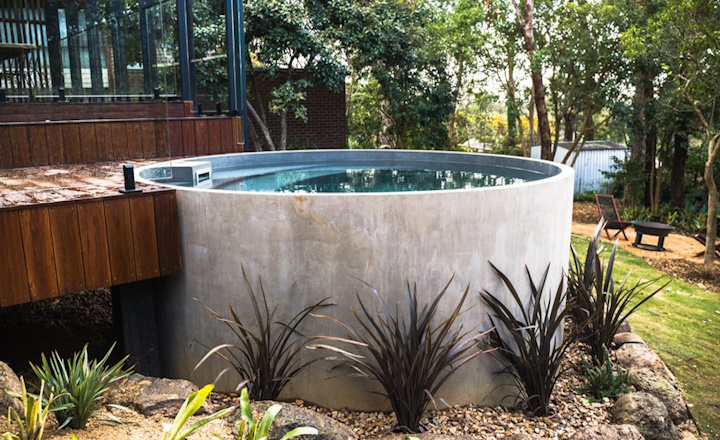
In many Australian suburbs, limited backyard space and strict compliance requirements make pool design a technical challenge. A concrete plunge pool offers a structurally engineered solution that balances compact design with long-term durability.
Homeowners researching layouts, materials, and installation options can review guidance on designing the perfect concrete plunge pool to understand how size, finishes, and placement influence long-term performance.
Structural Design and Construction Standards
A concrete plunge pool is built on site using reinforced concrete, allowing the structure to be engineered for soil conditions, drainage patterns, and site constraints.
Construction begins with excavation and ground preparation, followed by steel reinforcement installation. Concrete is then placed to form a continuous structural shell. Waterproofing systems and internal finishes are applied to protect the structure, after which plumbing, filtration, and circulation systems are installed and commissioned.
This method creates a monolithic shell that resists water pressure and ground movement. The Australian Corrosion Association identifies exposure classification, material specification, and detailing as primary factors influencing concrete service life in outdoor environments.
Concrete plunge pools, therefore, function as engineered assets rather than prefabricated products.
Unlike prefabricated fibreglass systems, a concrete plunge pool is engineered to site conditions, allowing reinforcement and detailing to be adjusted for soil classification and environmental exposure.
Performance in Australian Environmental Conditions
Australian residential pools are exposed to high ultraviolet radiation, temperature variation, seasonal rainfall, and coastal salinity in many regions.
Concrete construction allows designers to control reinforcement protection, cement composition, surface coatings, and waterproof membranes. These variables determine how well the structure resists corrosion, moisture ingress, and surface degradation.
The Commonwealth Scientific and Industrial Research Organisation (CSIRO) has identified environmental exposure as a major determinant of long-term concrete durability. When exposure conditions are properly assessed, plunge pools can be adapted for reactive soils, sloping blocks, and coastal environments.
Environmental resilience is achieved through engineering specification and construction quality rather than surface appearance.
Operating Efficiency and Maintenance Requirements
A plunge pool operates using standard circulation and filtration systems scaled to a smaller water volume.
Water is continuously circulated through pumps and filters to remove debris and contaminants. Chemical dosing maintains pH balance and sanitisation, while optional heating systems regulate water temperature.
Lower water volume generally results in reduced chemical consumption, shorter filtration cycles, and lower heating demand. However, routine maintenance remains essential. Regular testing, surface cleaning, and equipment inspection protect water quality and preserve interior finishes.
Efficiency is derived from system scale and equipment selection, not from reduced maintenance responsibility.
Safety Regulation and Legal Compliance
All private swimming pools in Australia are subject to mandatory safety regulations designed to reduce drowning risk.
Royal Life Saving Australia identifies residential pools as a significant contributor to childhood drowning incidents nationwide. As a result, strict fencing and access requirements apply across all states and territories.
Pool barriers must comply with AS 1926.1:2024, published by Standards Australia. This standard governs fence height, gate operation, non-climbable zones, and ongoing maintenance obligations. State and territory legislation enforces these requirements through inspection and certification processes.
Industry guidance from the Swimming Pool and Spa Association confirms that compliance must be integrated during design and construction, not added retrospectively.
Pool safety is therefore regulated infrastructure rather than an optional feature.
Property Value and Market Perception
A concrete plunge pool adds value to a property when it is compliant, proportionate to the site, and visually integrated with the home.
Buyers typically assess outdoor features based on construction quality, safety certification, maintenance condition, and landscape cohesion. Pools that appear poorly positioned or inadequately maintained can undermine buyer confidence.
By contrast, well-designed plunge pools tend to enhance outdoor usability, improve visual presentation, and reinforce perceptions of build quality. In many Australian markets, functional outdoor living space remains a significant factor in purchasing decisions.
Value is created through execution quality and regulatory compliance rather than pool size.
Customisation and Functional Design Features
Concrete construction enables permanent, site-specific customisation.
Integrated seating, entry steps, relaxation ledges, massage jets, and lighting systems can be built directly into the pool shell. These features improve comfort, accessibility, and year-round usability.
Interior finishes such as pebblecrete, ceramic tiles, quartz aggregates, and polished plaster influence slip resistance, heat absorption, cleaning frequency, and surface longevity. Finish selection therefore affects both appearance and long-term maintenance requirements.
Effective landscaping integration ensures appropriate drainage, access, and visual balance between the pool and surrounding structures.
Functional customisation delivers the greatest benefit when aligned with site conditions and usage patterns.
Planning and Engineering Considerations
Most long-term pool performance issues originate from inadequate early-stage planning.
Soil classification, groundwater behaviour, drainage pathways, equipment access, setbacks, and service connections must be assessed before construction begins. These factors influence structural stability and maintenance requirements throughout the pool’s lifespan.
Professional engineering input helps prevent shell movement, hydrostatic pressure damage, drainage failure, and structural cracking. Early technical planning reduces lifecycle costs and improves operational reliability.
Technical preparation determines long-term performance more than cosmetic upgrades.
Long-Term Investment Value
A concrete plunge pool delivers sustained value through structural longevity, adaptability, and regulatory stability.
Its primary benefits include extended service life, site-specific engineering, predictable operating costs, and consistent compliance with evolving safety standards. These characteristics support high usage rates and long-term household enjoyment.
For Australian homeowners balancing space efficiency, durability, and cost control, this construction method provides dependable performance. A professionally designed plunge pool supports recreation, recovery, and outdoor living without imposing excessive operational demands.
Long-term value is driven by engineering quality and integrity of compliance rather than short-term aesthetics.
| < Prev | Next > |
|---|