
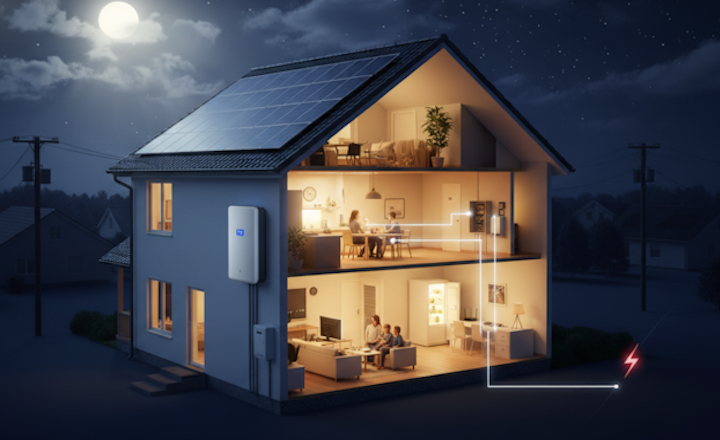
Last summer, a storm rolled through the eastern suburbs and knocked out power for six hours. The family three doors down had solar panels. They had a battery. And they sat in the dark for every one of those six hours, exactly like everyone else on the street. The system had been installed two years earlier. Nobody had ever explained that their battery was not set up for blackout protection. Nobody mentioned it was even possible. And nobody warned them that this is not a rare oversight. It is a common one.
Your battery and your backup are not the same thing
This is the part most people do not know before they start shopping.
A solar battery stores energy. That is its function. What it does with that energy during a grid outage depends entirely on how the system was designed. Many batteries sold and installed across Australia operate in what is called a grid-tied configuration. When the grid drops, the whole system, panels and battery together, shuts down automatically. This is a safety requirement, not a flaw. Electricians cannot work safely on live grid lines, and a system feeding energy back into a dead network puts them at risk.
The result is that a fully charged battery sitting on your wall delivers nothing during a blackout unless the system was specifically designed to provide backup capability, sometimes called islanding. That requires dedicated hardware, usually a hybrid inverter or a purpose-built product like the Tesla Powerwall, and it requires the installer to design for it from the very beginning.
If that conversation never happened during your quote process, you may have a system that performs exactly as sold. Just not as assumed.
"Whole home backup" is a phrase worth questioning
Even when a system does include proper blackout protection, the idea of powering your entire house rarely holds up under real conditions.
Consider what a Melbourne household runs on a January evening. An air conditioner pulling two to three kilowatts. An electric oven at three to four. A hot water system, a dryer, a second fridge in the garage. These are not passive loads. They cycle on and off constantly and they eat through stored energy fast. A 10 kilowatt-hour battery, a common size, can empty in under four hours under those conditions. That is not a failure of the battery. That is physics.
Solar battery backup done well is not about running everything. It is about running what matters. The fridge. The lights. A medical device. Phone charging. A single room air conditioner on a health-critical day. A well-designed system isolates a backup circuit containing only the essential loads and feeds those during an outage. The rest of the house goes dark while those circuits stay live.
That is a different conversation to the one most battery brochures invite you to have.
Sizing for the hours that count
Here is a practical way to think about it.
A typical Melbourne household in summer uses somewhere between 20 and 35 kilowatt-hours per day. Most of that lands in the morning and evening. If the goal is to carry essential loads, lights, a fridge, a ceiling fan, and device charging, through a 12-hour overnight outage, you are looking at roughly four to eight kilowatt-hours of demand, depending on the household. A 13.5 kilowatt-hour battery, properly configured and connected to a dedicated backup circuit, can carry that comfortably with capacity left over.
Add an air conditioner to that circuit and the calculation changes quickly.
The right way to size a backup system is to work backwards from your actual load, not forwards from a product specification sheet. A thorough site visit should cover your billing history, your usage pattern by time of day, and which appliances you genuinely cannot go without for 12 hours overnight. That conversation shapes the system. Without it, you are guessing.
Helcro Solar has been conducting those site assessments across Melbourne for over 18 years. Being a CEC Approved Retailer means assessments follow a defined standard, and what a proper site visit surfaces is not always what the customer expected going in. That is exactly the point.
What your panels do when the lights go out
One more thing worth understanding before you make a decision.
In most standard grid-tied systems, the solar panels also shut off during a blackout. The same safety mechanism that disconnects the battery disconnects the panels. On a bright Melbourne afternoon with the grid down, you may be generating nothing usable at all.
Some systems with hybrid inverters designed for backup can continue drawing from the panels to charge the battery and run essential loads during daylight, even with the grid offline. This is a real advantage during extended outages. It is also not a standard feature. It is a design decision that has to be made before the system goes in, not after.
What the right setup actually delivers
A household that has thought this through properly does not sit in the dark.
They know which appliances are on their backup circuit. They have talked through what happens if an outage stretches into the next day. They understand the air conditioner is off that circuit and they have a plan, a ceiling fan, cross-ventilation, somewhere else to go if it gets serious. Their fridge stays cold. Their medication stays stable. Phones are charged. There is light.
That outcome does not come from buying the most expensive battery available. It comes from working with a solar company in Australia that asks the right questions before designing anything.
The question is never really whether a battery can power your whole house. It is whether you know which parts of your house you actually need it to power. Get that answer right first, and the rest of the system follows.
| < Prev | Next > |
|---|