
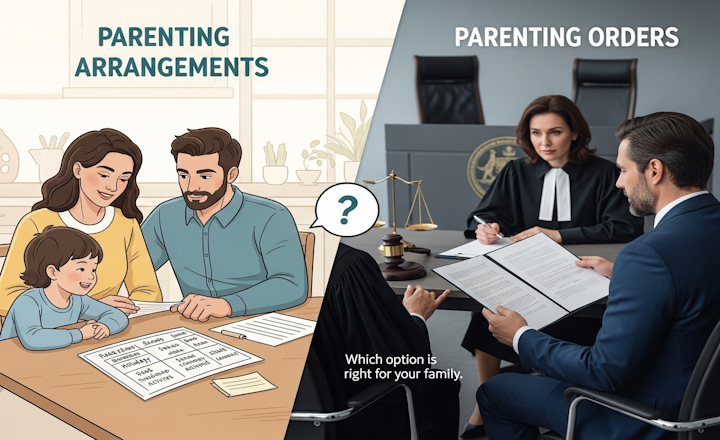
When parents separate, one of the most important and emotionally charged issues to resolve is how children will be cared for moving forward. Australian family law provides different pathways for formalising parenting responsibilities, with parenting arrangements and parenting orders being the two most common options. While these terms are often used interchangeably, they are quite different in both formality and legal effect.
Understanding the distinction can help parents make informed decisions that prioritise their children’s wellbeing while also protecting their own legal position. In many cases, related issues such as financial support may also arise, making early guidance from a family lawyer or a child maintenance lawyer particularly valuable.
What are Parenting Arrangements?
Parenting arrangements are informal agreements between parents about how their children will be cared for after separation. These arrangements are flexible and can be tailored to suit the unique needs of each family. They may cover matters such as:
- *Where the child lives
- *How much time the child spends with each parent
- *How special occasions such as birthdays and holidays are shared
- *How parents communicate about the child’s education, health, and general welfare
Parenting arrangements can be agreed to verbally or put in writing, such as through a parenting plan – however, unless formalised through the court, they are not legally enforceable.
Benefits of Parenting Arrangements
- *Encourages cooperation and open communication between parents
- *Faster and less expensive than court proceedings
- *Flexible and easier to update as circumstances change
Limitations to Consider
- *No legal enforcement if one parent fails to comply
- *Can create uncertainty if conflict arises later
- *May not provide adequate protection in high-conflict situations
Parenting arrangements are often suitable where parents have an amicable relationship and are confident they can work together in their child’s best interests.
What are Parenting Orders?
Parenting orders are legally binding decisions made by the Federal Circuit and Family Court of Australia. These orders set out specific parenting responsibilities and must be followed by both parents. Parenting orders may address:
- *Who the child lives with
- *How much time the child spends with each parent
- *Parental responsibility and decision-making authority
- *Communication methods between parents and children
- *Travel restrictions and changeover arrangements
Parenting orders can be made by a judge after a contested hearing, or by consent if both parents agree and apply jointly to the court.
Why Parents Seek Parenting Orders
- *To provide certainty and structure
- *To protect children in high-conflict or unsafe situations
- *To ensure arrangements are legally enforceable
- *To resolve disputes where agreement cannot be reached
Breaching a parenting order can have serious legal consequences, including fines, changes to the orders, or in extreme cases, imprisonment.
Parenting Arrangements vs. Parenting Orders: Key Differences
|
Parenting Arrangements |
Parenting Orders |
|
Informal or semi-formal |
Court-made or court-approved |
|
Not legally enforceable |
Legally binding |
|
Flexible and easy to change |
Changes usually require court approval |
|
Best for cooperative parents |
Suitable for high-conflict or complex cases |
Which Option is Right for Your Family?
There is no one-size-fits-all solution. Many families begin with parenting arrangements and only move to parenting orders if disputes arise or circumstances change. Others may require the certainty and protection of court orders from the outset, particularly where communication has broken down or safety concerns exist.
It’s also important to remember that parenting matters often overlap with financial responsibilities, including child support. Ensuring both parenting and financial arrangements are properly structured can reduce stress and conflict in the long term.
Getting the Right Legal Guidance
Whether you are considering informal parenting arrangements or need assistance applying for parenting orders, obtaining tailored legal advice can make a significant difference. A family lawyer can help you understand your rights and obligations, draft clear agreements, and guide you through court processes if required. Most importantly, the right advice helps keep the focus where it belongs—on creating stable, practical arrangements that support your child’s best interests now and into the future.
| < Prev | Next > |
|---|