
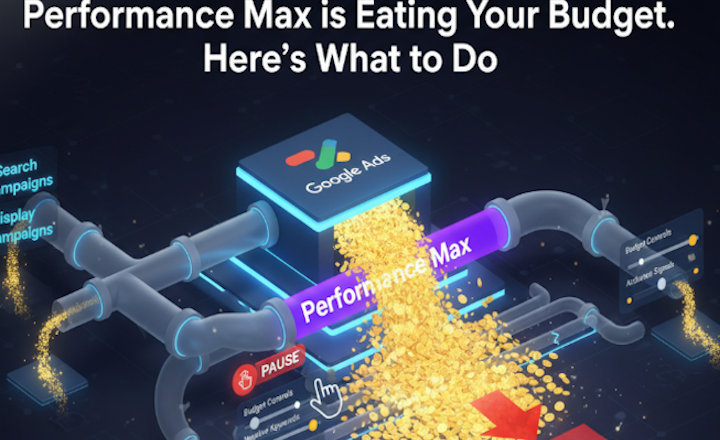
Google built Performance Max to spend your budget efficiently.
Efficiently for Google.
That distinction matters. And most brands find out too late.
What PMax Was Sold As
The pitch was compelling. One campaign. Every Google surface. Search, Display, YouTube, Shopping, Gmail, Maps. All of it, automated. Smarter targeting. Better results. Less manual work.
For time-poor founders and under-resourced marketing teams, it sounded like the answer to a problem they'd been dealing with for years.
What nobody said clearly enough is that "automated" and "optimised for your business" are not the same thing. PMax is optimised to convert. The question nobody asked is: convert who, from where, at what actual cost to new revenue?
The Five Ways It Burns Your Budget
It hides where your money goes.
PMax consolidates every Google placement into a single campaign and allocates budget automatically. You get a total spend figure and a reported ROAS. What you don't get is a breakdown of where that spend actually went. How much hit YouTube. How much went to Display placements nobody would have approved manually. How much ran on apps your audience doesn't use. The opacity isn't a bug. It's the design.
It charges you for customers you already had.
PMax reaches into branded searches. People typing your business name directly into Google, already intending to find you, get served your PMax ad. You pay for the click. The conversion gets logged. Reported ROAS climbs. Incremental revenue stays exactly where it was, because that customer was coming regardless.
This is the most common source of ROAS inflation in accounts running PMax without brand exclusions. It looks like performance. It isn't.
It hides the search terms that triggered your ads.
Standard Search campaigns show you every query that matched your ads. You can cut irrelevant terms, double down on high-intent ones, and build a smarter negative keyword list over time. PMax shows you almost nothing. You cannot see what triggered your spend. You cannot optimise what you cannot see.
It competes with your own campaigns.
PMax holds campaign priority over standard Search and Shopping campaigns. In practice, this means PMax actively competes for and wins the queries your existing campaigns were already converting on, often at a higher cost per click, then takes the credit. Well-structured campaigns that were working get cannibalised. Performance looks consolidated. What's actually happened is your best-performing traffic got more expensive.
The learning phase is a paid experiment.
Before PMax delivers anything useful, it needs to learn. That learning phase takes weeks and costs real money. For brands without large budgets or significant conversion volumes, the algorithm may never exit the learning phase before the campaign gets paused. The budget spent in that window is essentially tuition paid to Google's machine, with no guaranteed outcome.
The ROAS Illusion
Here's where it gets expensive.
PMax is built to hit ROAS targets. The algorithm is very good at that. The problem is it hits those targets by chasing the easiest conversions available, branded clicks, returning customers, bottom-of-funnel users who were already deciding. These conversions are real. The revenue attached to them is not incremental.
Meanwhile, Marketing Efficiency Ratio, the ratio of total revenue to total ad spend, tells a different story. When you calculate what your blended return actually looks like across every dollar going into Google, the picture shifts. PMax inflates channel ROAS while MER quietly deteriorates.
Founders running PMax alongside a marketing agency that only reports channel ROAS are seeing great numbers on paper while actual business growth stalls. The dashboard looks fine. The revenue doesn't move.
The tell is simple. Pause PMax. If revenue barely changes, PMax was harvesting demand, not creating it.
What to Actually Do
These are not theoretical fixes. They are specific actions.
Add brand exclusions immediately. Stop paying Google to show your ads to people already searching for you by name. This is table stakes. Any account running PMax without brand exclusions is leaking budget on conversions that were never at risk.
Segment asset groups properly. Most brands dump everything into one asset group. PMax mixes all of it together and serves whatever combination the algorithm favours. Separate asset groups by product category, audience intent, and offer. Give the algorithm something specific to work with, not a pile of assets it can combine arbitrarily.
Keep structured Search campaigns running. Do not replace existing Search campaigns with PMax. Run them alongside. Set campaign priorities correctly. Protect your highest-converting query types from being absorbed into the PMax black box.
Pull the placement report. Under Insights and Reports, campaign URL reports give you partial visibility into where your Display and YouTube budget went. Use it. Exclude placements that have no business serving your ads. This won't give you full transparency, but it's what's available.
Measure with MER, not just ROAS. Total revenue divided by total ad spend. Every week. If MER is declining while reported ROAS holds steady, PMax is taking credit for organic and returning revenue. That's the signal to restructure.
Set audience signals deliberately. PMax uses audience signals as a starting point, not a hard constraint. But a well-structured signal list, built from your actual customer data, CRM lists, high-intent site visitors, pushes the algorithm toward new customer acquisition instead of demand harvesting. Most accounts have no audience signals set at all.
The Bigger Lesson
Automation is not a strategy. It's a tool.
PMax run without structure, without exclusions, without incrementality tracking, and without someone actively interrogating the outputs is not a performance campaign. It's a budget allocation system optimised for Google's revenue, not yours.
The brands that get real results from PMax are the ones treating it as one component inside a structured account, not a replacement for strategic thinking. They know what it should and shouldn't touch. They measure what it actually contributes. They're not impressed by ROAS numbers that don't connect to revenue growth.
The brands quietly haemorrhaging budget are the ones whose digital marketing agency in melbourne set PMax live, pointed at it in a monthly report, and called the ROAS a win.
Automation rewards the brands that understand it well enough to control it. UNTMD works with Australian founders and growth brands to engineer accounts built around real revenue, not flattering dashboards. Every other brand is just funding the experiment.| < Prev | Next > |
|---|