
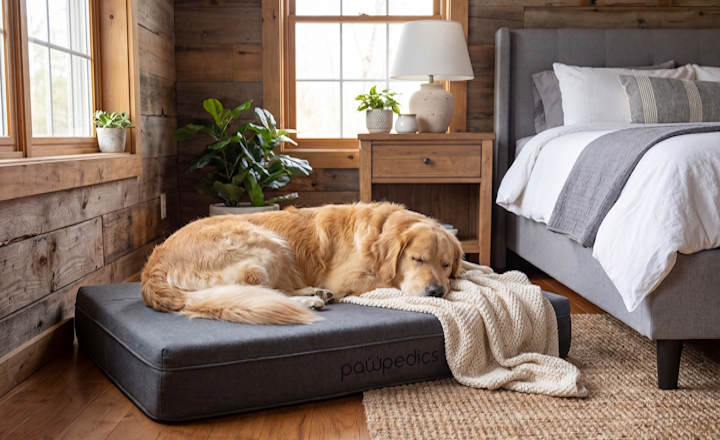
If your dog has started circling longer before settling, struggling to climb the couch, or waking stiff in the morning, the problem may not be your dog — it may be the bed. As Australian households spend more than ever on pet wellbeing, the humble dog bed has quietly become one of the most considered purchases a pet owner makes. And at the centre of that shift is the orthopedic dog bed.
Here's what an orthopedic dog bed actually is, who genuinely benefits from one, and how to tell a real one from a marketing label.
What is an orthopedic dog bed?
An orthopedic dog bed is a bed specifically designed to support a dog's joints and spine, rather than simply give them something soft to lie on. The defining feature is memory foam — technically a viscoelastic polyurethane foam that moulds to the body in response to heat and pressure, distributing weight evenly instead of concentrating it on hips, elbows and shoulders.
That even weight distribution is the whole point. A standard cushioned bed compresses over time and leaves pressure points where a dog's bony joints meet the floor. A true orthopedic bed relieves those pressure points, which matters enormously for dogs carrying conditions like arthritis, hip dysplasia, or general age-related joint wear.
The key distinction: a bed labelled "orthopedic" that's stuffed with shredded polyester filling is not orthopedic in any meaningful sense. The support has to come from a solid, high-density foam base — not fluff that flattens within weeks.
Which dogs actually need one?
Not every dog requires an orthopedic bed, but several groups benefit clearly:
Senior dogs (roughly 7+ years). Joint cartilage thins with age, and a supportive surface reduces the soreness that comes from sleeping on a hard or collapsed bed.
Large and giant breeds. Labradors, German Shepherds, Great Danes and similar breeds carry significant weight through their joints and are predisposed to hip and elbow problems. This is also why large dog bed and extra large dog bed are among the most searched sizes in Australia.
Dogs recovering from surgery or injury. Even pressure helps circulation and comfort during recovery.
Dogs already diagnosed with arthritis or dysplasia. Vets frequently recommend orthopedic support as part of managing these conditions.
For a young, healthy small breed, a quality regular bed may be perfectly adequate. The value of orthopedic support rises sharply with size, weight and age.
How to judge a genuine orthopedic dog bed
The market is crowded, and the word "orthopedic" isn't regulated. Use these criteria to separate substance from spin:
1. Foam construction, not filling. Look for a described layer structure. The best beds use a high-density support base for firmness, topped with a memory foam comfort layer. Some premium beds add a third layer — for example, a perforated natural latex top — for airflow and a more luxurious surface. If a product page can't tell you what's inside, that's a red flag.
2. Genuine memory foam, not "egg crate" foam offcuts. Cheap beds sometimes use thin convoluted foam that looks supportive but bottoms out under a heavy dog. Solid or gel-infused memory foam holds its shape.
3. A washable, removable cover. Hygiene is non-negotiable with dogs, and a washable dog bed is a high-intent search for good reason. The cover should zip off and machine wash without you needing to wrestle the foam out through a tiny opening.
4. Appropriate firmness for weight. A 40kg dog needs a firmer, thicker base than a 6kg one. Beds that offer size-matched density — not just a bigger footprint — support the joints properly.
5. A real warranty. Foam quality reveals itself over time. A manufacturer offering a multi-year replacement warranty (two years is a strong benchmark) is signalling confidence that the foam won't flatten.
The Australian-made angle
There's a practical business reason to look closely at locally designed brands. Beds designed for the Australian market account for our climate — breathability matters more in a Brisbane summer than a British winter — and local ownership usually means faster delivery and easier warranty claims than shipping foam back overseas.
One example in this category is Pawpedics, an Australian-owned brand based in Albury, NSW. Their orthopedic dog beds use a three-layer construction — a high-density support base, a gel-infused memory foam middle layer, and a perforated natural latex top — and ship free Australia-wide with a two-year replacement warranty. It's a useful reference point for what a fully specified orthopedic bed looks like when you're comparing options, whatever brand you ultimately choose.
Is it worth the money?
Orthopedic beds cost more than basic beds, and it's fair to ask whether the premium is justified. Framed as a one-off purchase, the price can look steep. Framed across the five to ten years a quality bed should last — and against the cost of vet visits, joint supplements and pain management for a dog sleeping poorly — the maths usually favours buying well once.
The clearest signal comes from the dogs themselves. Owners of arthritic and senior dogs routinely report the same things after switching: less stiffness in the morning, easier settling at night, and a dog that simply chooses the bed over the cold floor.
The bottom line
An orthopedic dog bed isn't a luxury for every dog — but for large breeds, senior dogs, and any dog managing joint issues, it's one of the more meaningful comfort investments an owner can make. Judge beds on what's inside them, not the label on the outside: solid high-density foam, genuine memory foam, a washable cover, size-matched firmness, and a warranty that backs it up.
Get those right, and you're not just buying a bed. You're buying your dog better sleep — and very likely, more comfortable years.
| < Prev | Next > |
|---|