
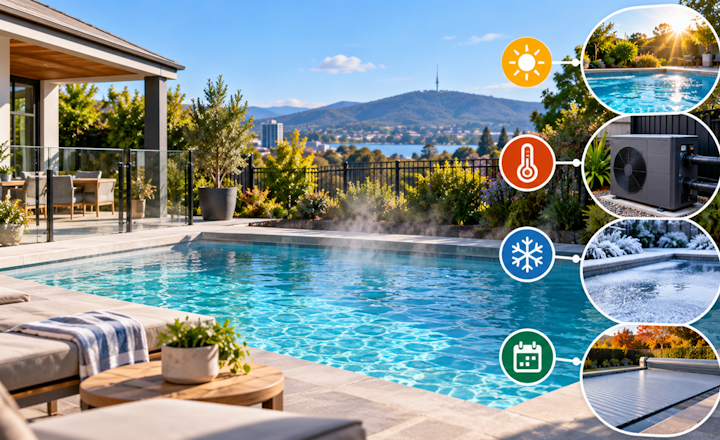
Canberra has one of the strangest climates of any Australian capital, and anyone who has lived here through a full year already knows it. Summer days regularly push past 35 degrees with dry, cracking heat that makes a pool feel less like a luxury and more like basic infrastructure. Then winter arrives and mornings sit below zero, frost coats the lawn, and the same backyard that felt like the Mediterranean in January turns into something closer to the Snowy Mountains.
That swing matters enormously for pool design, way more than most first time pool owners expect going in. A design copied straight from a Gold Coast display home, built around year round mild weather, simply will not perform the same way once it is sitting in a Canberra backyard through a July morning frost.
Start with heating, because it is the single biggest factor separating a pool you use three months a year from one you actually use most of the year. Canberra's cold snaps are dry and sharp rather than damp, which actually works in your favour for heat pump efficiency, but only if the system is sized correctly for the volume of water and the exposure of your particular block. A pool tucked into a suntrap against a north facing wall in Kambah behaves completely differently to one sitting exposed on an open, windy block out in Gungahlin, even if both pools are identical in size.
Plus, insulated pool covers matter far more here than they do in warmer capitals. A quality thermal cover can cut heat loss overnight dramatically, and given how hard Canberra's radiant frost nights work against a heated pool, skipping a cover is basically throwing heating dollars straight into the cold night air. It sounds like a minor accessory decision, but in this climate it is closer to a core design choice.
Frost itself creates its own set of headaches beyond just cold water. Exposed pool equipment, pumps, filtration lines and above ground plumbing can be vulnerable to freezing overnight if they are not positioned or insulated properly, and a cracked pipe from an unexpected hard frost in June is an expensive, annoying repair nobody wants mid winter. Good design accounts for this from day one, running lines below frost depth and shielding equipment enclosures rather than trying to retrofit protection after the first cold snap causes damage.
Materials matter too. Coping and paving that look fantastic in a warm coastal climate can behave very differently once they go through Canberra's constant freeze thaw cycle across a typical winter. Certain natural stones absorb moisture, then crack or flake when that moisture freezes and expands overnight. Choosing coping and decking rated for genuinely cold climates, not just generic Australian conditions, avoids a coping edge that looks tired and pitted after just a couple of winters.
So what about actually using the pool outside of the peak summer months? This is where the off season use conversation gets interesting, because a well designed, well heated pool in Canberra can genuinely extend into a nine or ten month season rather than the three month window most people assume is the ceiling. Add a cover, a correctly sized heat pump, and maybe a section with hydrotherapy jets, and a chilly Canberra evening in April or September becomes a perfectly comfortable time for a soak rather than a swim you rule out entirely.
This is exactly why local experience counts for more than most people assume when picking who builds the thing. a Canberra specific pool builder understands the difference between a generic east coast pool spec and one engineered for Canberra's particular combination of dry heat, hard frost and everything in between, because getting it wrong here is not a minor inconvenience, it is a pool that sits unused for half the year or costs a fortune to run.
There’s also a compliance layer sitting underneath all of this. Heating equipment, pump enclosures and pool covers all need to work within the safety barrier requirements enforced by the ACT, regardless of the climate considerations involved.
The ACT’s pool approval and fencing requirements are worth reviewing alongside any climate-specific design decisions, so your plans meet both practical and regulatory requirements without one working against the other.
None of this is meant to talk anyone out of building a pool in Canberra. If anything, the opposite. Getting the climate specific details right at the design stage, heating capacity, cover choice, equipment placement and frost tolerant materials, turns a pool from a three month novelty into something the household genuinely uses most of the year, which changes the entire value equation on what is otherwise a significant investment.
The takeaway is straightforward even if the technical details are not. Canberra's climate is unusual enough that copying a design brief from a warmer capital is a mistake, but planning specifically for our dry heat, sharp frosts and long cold snaps turns those same conditions from an obstacle into something a well built pool can handle without breaking a sweat, or freezing a pipe, either way.
Wind exposure deserves its own mention too, since Canberra throws some genuinely blustery days at homeowners, particularly through late winter and early spring. A pool sitting on an exposed block loses heat through evaporation far faster than a sheltered one, even with identical heating equipment installed. Simple design choices like a low windbreak wall, strategic hedging or positioning the pool behind an existing structure can cut that evaporative heat loss noticeably, which translates directly into lower running costs over a full season rather than just a summer.
Solar heating is worth a genuine look here too, and not just as a token green feature. Canberra gets plenty of clear, sunny winter days even when the air temperature is bitterly cold, and a well sized solar system paired with a heat pump as backup can carry a huge share of the heating load on those bright but chilly days, which are honestly more common here than most people expect once they start paying attention to the forecast.
Landscaping choices around the pool also need a second look through a Canberra specific lens. Plants that thrive in a Sydney courtyard pool surround can struggle or die back hard through an ACT winter frost, leaving a bare, patchy garden bed right when the pool area should still look presentable even if nobody is swimming. Choosing frost hardy species for the immediate pool surrounds keeps the whole space looking intentional across all four seasons rather than just the warm ones.
Automation has quietly become part of the climate conversation too. Smart controllers that track overnight temperature forecasts can fire up heating earlier on nights expecting a hard frost, or delay it slightly on milder evenings to save on running costs. It sounds like a small convenience, but over a full Canberra winter those small daily adjustments add up to a noticeably lower power bill compared to a system left running on a fixed, uniform schedule regardless of what the weather is actually doing outside.
| < Prev | Next > |
|---|