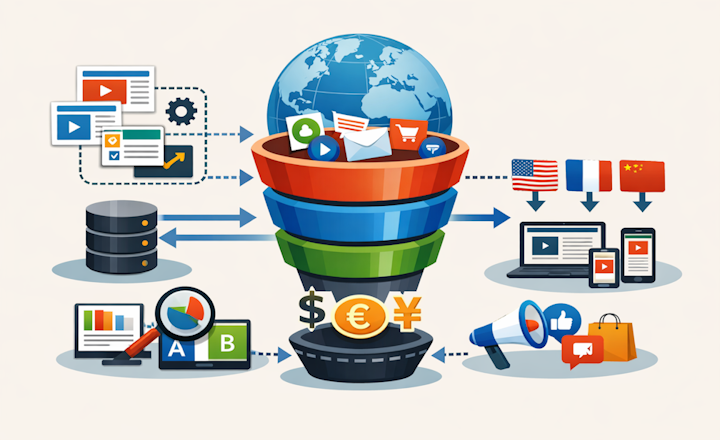
Global marketing funnels need to expand into different languages. Customers expect relevant marketing communications to be tailored to their needs, and funnel localization creates much more impactful engagement and conversion. However, organizations typically duplicate their funnels and associated content and assets to service each region in a new language. While this may be the easiest option in the short term, it gives way to content sprawl, ineffective messaging updates, and operational inefficiency before long.
Duplication creates workflows that are untenable for long-term maintenance. Unless messaging can be updated at the same time in all languages, organizations can find themselves with inconsistent similar messaging across languages or too many languages messaging with outdated facts. Instead, structured content provides sustainable long-term strategies for multilingual funnel development by separating language differentiation from foundational structure. By separating a logical architecture of content into modular components and managing translations from a central location, organizations can develop multi-language funnels without duplicating efforts. This article explains how these structured realities make a global funnel management scalable.
Non-Duplicative Multilingual Funnel Structure
The best way to build a non-duplicative multilingual funnel is by separating structure from language. Headless CMS for enterprise flexibility makes this possible by allowing reusable content components to adapt across languages without duplicating entire pages. Organizations do not have to create separate pages and builds for every language. Instead, they can establish a funnel structure with reusable components.
Within that funnel structure, however, are fields for language embedded into each region. For example, headlines, descriptions, calls to action and testimonials would all have separate language variances within the same funnel entry where the structure remains the same. What content shows up will change depending on the user's language.
Language differentiation does not change the structure. If there's an update to the structural component, it only needs to be done once across the board. If any adjustments need to be made in language, it's compartmentalized into those separate fields. After a while, this eliminates repeat builds and makes global efforts easier.
Translation as a Bottleneck for Multilingual Funnels
Translation services slow down multilingual funnels. The minute the content is duplicated and created on separate pages, it's created for translation work on unnecessary levels. Translators need to acknowledge updates per page while revisions become complicated.
Centering translation efforts work better from structured systems. Specific fields for language provide more accessibility for translation management systems through API integrations. When something in source text is updated, translation triggers go off so the newly localized fields can stay on the same page.
This promotes a quicker turnarounds for campaign launches. There's no need to build extra pages for market language. The same modules can simply be fine-tuned for a faster process in one working system.
Preserve Funnel Infrastructure Across Borders/Regions
Marketing funnels are built for their structural integrity. When content becomes duplicated in different languages, and international borders or regions start making additional changes, funnel structural integrity can succumb to drift.
Instead, by creating one structurally sound piece across languages, the logic inherent within its structure maintains its relevance across the board. Educational modules will always come before comparison pieces; they'll never switch order just because two markets prefer something else.
This philosophy champions integrity and structure above all else to align with a bigger picture and structural trust that results in better conversions through cohesive steps in a funnel process that's also guaranteed by the organization to remain the same.
Facilitating Uniform A/B Testing Across Languages
Experimentation is critical to funnel improvement. Yet it's challenging to run tests when separate language versions are created on their own. What works better in Spanish won't necessarily be comparable to what's better in English if web elements differ.
With structured multilingual approaches, testing occurs component by component with the same overarching design. One headline can be tested for response against another in one language while simultaneously testing similar calls to action elsewhere. Analytics will report relative performance since taggers remain intact.
This relative ease makes insights better. Teams will determine if certain ways of saying the same thing works better in one culture versus another yet champions architectural integrity. Thus, A/B testing becomes an optimization, not a guessing game.
Enabling Localization Beyond Translation
Much more than just translation is required to ensure multilingual funnels are effective. For example, cultural nuances, regulations and local preferences can change how a message is received. But with structured solutions, it doesn't mean excess work to accommodate.
Locally-sourced modules might be connected testimonials, disclaimers required by law, or promotional messages allowed in region but not anywhere else. Conditional logic assesses geographic parameters to trigger what shows.
This ensures that localization efforts truly accommodations are made without diverging from the structural approach. Teams connect their messaging efforts but maintain a level of centralized ownership.
Decreasing Maintenance Effort with Changes
Inevitably, campaigns must change. Pricing must increase, features must develop, and promotions must evolve. If teams take the time to replicate assets across different language versions of a funnel, it's even more time-consuming when systems are less connected.
Structured solutions promote streamlined maintenance. Appropriate structural changes occur once across the interconnected set-up. The only fields that update are language-based and pulled from within a similar structured module.
This drastically reduces operational burden. As funnels become easier to create across more languages, maintenance will not scale proportionately. Instead, it remains manageable.
Bringing Multilingual Funnels Together with Omnichannel Efforts
Marketing funnels extend beyond the website into email campaigns and mobile apps, so multilingual variances across channels make it even more complicated to keep things aligned but when segmented systems are in place, it's much harder to achieve.
A unified content library allows for omnichannel distribution. Structured modules feed web, email and app interactions with diverse but consistent lived experiences. Updates are made universally across channels.
Thus, the language of the funnel is the same across the funnel universe. Whether a user enters via email or digital asset, they will receive the same message bolstering brand trustworthiness.
Using Analytics to Optimize Performance Over Time
Performance trends will differ from region to region. But with a structured content library, analytics exist at the module level to determine how different languages are performing.
This means engagement statistics can be compared across languages to see what resonates best in which market. Then, local fields can be optimized without touching the global structure. Fine-tuning through data improves conversions without losing coherence.
Over time, analytics help bolster multilingual funnel success and global messaging.
Facilitating Future Global Market Expansion
As companies venture into new markets, duplicated funnels become unnecessarily complicated. The more languages that are added, the more complicated maintenance becomes.
Structured systems offer ease for expansion. Adding a language means extending existing fields rather than rebuilding funnels from scratch. APIs help get the message out across all platforms.
Thus, the company is ready for globalized expansion. New markets are integrated into the existing system easily without losing any semblance of cohesion or structure needed for expansion.
Avoiding Version Drift Between Language Variants
One of the biggest pitfalls of funnel management multilingual is version drift. When there is a funnel for each language, updated versions are not necessarily the same in each language. Gradually, small changes over time lead to different offers, specs, or even general tone. Version drift weakens brand credibility and makes performance assessment more difficult.
Structured content solutions keep version drift at bay. All language versions have the same structural components since they're one funnel with centralized modules and fields for the respective languages. Therefore, if something changes pricing logic, compliance language or features it applies to all language versions.
Centralized governance avoids this drift in the first place. Instead of assessing multiple builds to look for inconsistencies, teams can make adjustments in one place and keep everything built out in one architecture. Version control is maintained and as funnels change, all markets change together.
Defining Ownership Between Global and Local Teams
Multilingual funnel management is contingent on effective ownership. If ownership is unclear, global teams will get the upper hand and situational nuance will be lost or local teams will attempt to connect certain standards that cannot apply globally and create a lack of cohesion. Ownership leads to duplication.
Structured CMS solutions provide access to permission models that determine ownership. Global teams will be responsible for master language components and structural inclusions while local teams will be responsible for updates in purely language fields or regions-specific components. Approval efforts will keep accountability levels aware.
This means reduced friction and no redundant build. Instead of conflicting efforts, global and regional teams share the same language. Ownership that's structured makes creative ownership aligned with governance so that what could become fragmented actually becomes seamlessly scalable in a localized approach.
Enhanced Compliance Abstraction to Support Industry Differences
Industries may feature different regulations around regions. Whether it's a privacy notice, a promotional disclaimer or legal language, duplicative CMS funnel systems need updates for every language meaning increased effort all around.
With a structured content solution compliance modules can be set once and adjusted in the language-required fields, via conditional logic that allows regionally-enabled disclaimers and notes to appear without changing the funnel mechanics. Legal language can be set at one level and applied where necessary based on region.
This means less duplication and risk for compliance needs. Instead of rebuilding for compliance nuances, teams can adjust those specific modules. Over time, what's structured helps comply with less need for effort across each version.
Establishing a Future-Facing Multilingual Funnel Content Architecture
Sustainable multilingual funnels do not grow naturally, but rather, with foresight. Instead of treating the addition of another language like another production project, an eventual roadmap to expansion and re-structuring positions organizations for more success down the line.
Structured content architecture contains the flexibility for roadmap-focused growth. Within existing structures, language fields can be added to support newly-introduced markets. Data-driven insights can help iteratively refine global and locale-based modules. Governance decisions evolve naturally through expansion.
When multilingual funnels are treated like an ever-growing strategic endeavor instead of separate builds, organizations can scale far more effectively. Content remains coherent across languages and growth is sustainable as multinational efforts become broader and broader.
Supporting Multilingual Funnels with Cross-Marketing Analytics
Building funnels in multiple languages without duplication is more than just a structural advantage; it's an easier-to-measure, cross-market analytics effort. When there are separate funnel builds for each language, performance data can become muddled. Metrics can reflect differences in structure instead of audience engagement.
Structured content architecture allows funnel stages, modules, and identifiers to be consistent across languages. Thus, measurement platforms can find aggregated metrics across languages that only refer to the language/cultural nuances instead of structural differences. This level of clarity empowers marketing teams to know which elements of localized messaging may have higher engagement or conversion rates.
As time goes on, aggregated analytics supports a globalized strategy. What does well in one market can help evolve another without compromising structural integrity. The only thing consistent among these enterprises is the measuring tools that help transform localization into a quantified growth engine.
Future-Proof Multilingual Funnel Architecture for Newer Touch Points
As digital spaces change, funnels extend beyond websites to mobile apps, chat options and connected devices. Where architecture isn't extensible and purposeful, multilingual variances on these fronts may only exacerbate duplicative concerns.
A centralized CMS with modular content means multilingual components are adaptable. Language fields are not only in structure but support email funnels, in-app content and future-facing options via API development for omnichannel use. Newer options don't require rebuilding the wheel from a multilingual perspective.
Future-proofed architecture safeguards against future scalability. If market reach increases with touch point options, the multilingual funnel remains easy and efficient for everyone. Only specific distribution methods and language considerations transform the funnel, but not a rebuild from scratch. Centralized governance and structured funnel design make future challenges easier.
Conclusion
Creating multilingual funnels for marketing purposes without duplication relies upon a structure where content and structure are separated. When translations occur from a centralized process that maintains the integrity of the funnel, but subsequently, updated translations do not require a reinvention of the wheel for each funnel, duplicate creation efforts are avoided.
Structure supports consistent testing, analytics-based revisions, and omnichannel distribution across markets. Localization efforts become scalable, instead of chaotic.
In a globalized digital arena, a disciplined content modeling approach renders multilingual funnels cohesive, adaptable and growth-oriented without sacrificing operational sanity.
| < Prev | Next > |
|---|