
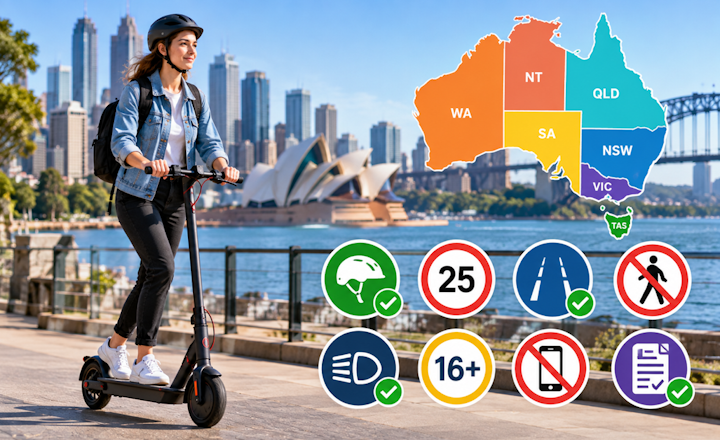
Buying an electric scooter feels simple right up until you realise the rules change depending on which side of a state border you happen to be standing on. One suburb over and suddenly your perfectly legal commute becomes a fine waiting to happen. So what's actually going on, and how do you avoid becoming a cautionary tale on your local Facebook group?
Let's sort through it state by state, because lumping "Australian e-scooter law" into one tidy paragraph is exactly the kind of oversimplification that gets people in trouble.
New South Wales
For a long time NSW was the strictest state going, with private e-scooters banned from public roads and paths entirely, only allowed on private property. That's shifted. Trials have expanded in select council areas including parts of Sydney, and legislation has been moving toward broader legalisation, but it is still patchy rather than blanket. Before you assume your ride to the station is fine, check whether your specific council is part of an active trial zone, because riding outside one still carries real penalties.
Victoria
Victoria took a more permissive stance early, allowing e-scooters on roads with speed limits under 50 kilometres per hour and on shared paths, generally capped around 25 km per hour. Helmets are compulsory. Riding on footpaths where pedestrians are the priority is generally restricted to shared paths rather than standard footpaths, so know the difference before you assume any path will do.
Queensland
Queensland has been one of the friendlier states for scooter commuters, treating them similarly to bicycles under road rules in many respects. Footpath riding is allowed at reduced speed in a lot of areas, road riding is permitted where speed limits are low, and helmets are mandatory. Brisbane in particular has leaned into scooter infrastructure, which makes sense given how much of the CBD commute crowd has adopted them.
Western Australia
WA permits e-scooters on shared paths and roads with lower speed limits, following a similar model to several eastern states, with speed caps that riders genuinely need to respect because enforcement has picked up noticeably in Perth over the past couple of years. Helmet use is compulsory here too, and riders under a certain age face additional restrictions worth checking directly with local authorities since these details get updated periodically.
South Australia
South Australia allows e-scooters under conditions broadly comparable to Queensland and WA, permitting use on shared paths and certain roads. Adelaide has embraced share scheme scooters visibly, which has nudged private ownership rules toward similar clarity, though as always, local council bylaws can add extra layers on top of state law.
Tasmania, ACT and the Northern Territory
Tasmania and the ACT both permit e-scooter use with speed and location restrictions comparable to the more permissive mainland states, generally allowing shared paths and low speed roads with helmet requirements attached. The Northern Territory has been slower to formalise scooter specific rules, meaning riders there should lean on general bicycle adjacent regulations until clearer scooter specific law lands.
Why This Keeps Changing
Here's the honest answer. Councils and state governments are still figuring out how much freedom to give these devices, and every serious injury reported in the news tends to trigger a fresh review somewhere. Plus, share scheme scooters from providers like Beam or Neuron often operate under separate agreements to private ownership, which is why you'll sometimes see share scooters permitted in a zone where riding your own would technically not be.
That gap confuses a lot of new riders, understandably. A share scooter parked on a footpath doesn't automatically mean private scooters share the same legal status in that spot.
What This Means If You're Commuting Regularly
If you're using a scooter to get to work or uni several days a week, treat the legal side the same way you'd treat car registration. Check your specific council's current position, not just your state's general stance, because inner city councils frequently run their own overlay rules. Keep a helmet in your bag even on days you think you won't need it, since fines for riding without one are handed out more often than people expect.
Speed limiters matter here too. A lot of higher powered models can technically exceed the legal cap for road or path use, and riding one unmodified in a restricted zone puts you at fault even if the scooter itself is a legitimate, well built machine. If you're shopping around, it's worth looking at models built with compliant speed settings in mind, such as the current Segway and Ninebot electric scooter range, which tend to ship with settings that align more easily with common state restrictions.
Practical Compliance Checklist
A few things worth locking in regardless of which state you're in.
Always wear a helmet, since this is close to universal across states even where other rules diverge. Confirm whether your local council has an active trial or permanent scheme, because NSW especially still has pockets where private scooters simply are not permitted yet. Respect posted speed caps on shared paths, typically sitting around 25 km per hour, since this is where enforcement has visibly tightened. Avoid standard footpaths unless your specific state and council explicitly allow it, and don't assume a shared path designation covers every footpath nearby.
The Bottom Line
Australian e-scooter law is a genuine patchwork right now, shaped state by state and sometimes suburb by suburb. That's not going to simplify overnight, so the safest approach is treating your own council's website as the actual source of truth rather than relying on what a mate in a different postcode tells you works fine for them.
For a broader look at how these rules intersect with choosing the right model for your commute, this guide on electric scooter regulations and buying considerations walks through the practical side in more depth.
Stay legal, wear the helmet, and check before you ride somewhere new. It's a small habit that saves a genuinely annoying fine.