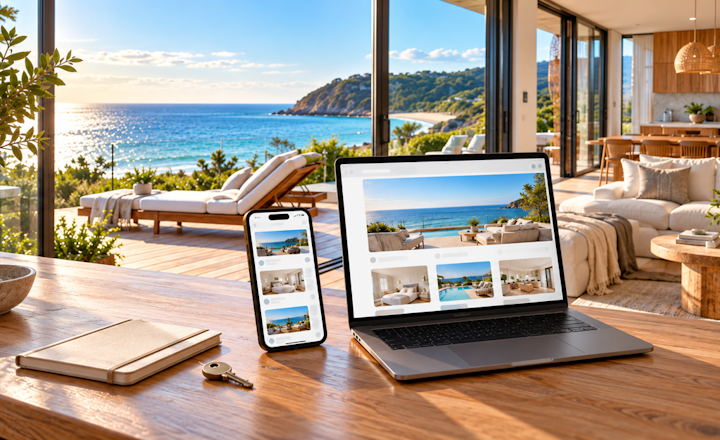
For holiday rental owners across New South Wales, South Australia and South East Queensland, the question of where to list a property is no longer a simple either/or decision. Airbnb has become a dominant force in short-term accommodation, but savvy owners are increasingly recognising that relying on a single platform can leave money on the table and control in someone else's hands. This article examines the marketing channels, booking costs and revenue opportunities associated with both Airbnb and direct bookings, and explains why a blended approach — often best managed with the help of a professional holiday rental property management company — tends to deliver the strongest results.
Marketing Channels - Reach vs Relationship
Airbnb's greatest strength is its built-in audience. The platform attracts millions of travellers browsing for accommodation in coastal towns along the NSW South Coast, wine regions in the Adelaide Hills and Barossa Valley, and popular getaways throughout the Sunshine Coast and Gold Coast hinterland. For a new property or an owner just starting out, this exposure is invaluable — it removes the need to build an audience from scratch and puts a listing in front of travellers who are already in "booking mode".
However, this reach comes at a cost to the owner's control over marketing. Airbnb's search algorithm determines visibility, pricing display, and how a property is positioned against competitors, and owners have limited ability to differentiate their brand within the platform's standardised format. Guests booking through Airbnb are, in a very real sense, Airbnb's customers first and the property owner's second.
Direct booking channels — a dedicated property website, social media presence, email marketing to past guests, and search engine visibility — offer a very different proposition. While building this audience takes time and consistent effort, it allows owners to:
- Establish a distinct brand identity for their property or portfolio- Communicate directly with guests before, during and after their stay
- Build a repeat guest base and encourage word-of-mouth referrals
- Showcase unique selling points (proximity to Barossa cellar doors, direct beach access on the NSW coast, or family-friendly features near Noosa or the Gold Coast) in ways that suit the property, rather than a generic template
Many successful owners treat these two channels as complementary rather than competing. Airbnb builds initial visibility and guest volume, while direct channels are used to convert first-time Airbnb guests into repeat direct bookers over time — capturing their contact details and inviting them back without the platform as an intermediary.
Booking Costs - Understanding the True Impact on Yield
One of the most compelling reasons to diversify beyond Airbnb is cost. Airbnb charges service fees to both hosts and guests, and while these fees fund genuine value (secure payments, customer support, insurance protections and dispute resolution), they add up. Over a full year of bookings, host fees can represent a significant reduction in gross revenue — money that, on a direct booking, would otherwise stay with the owner.
Direct bookings are not free of cost, of course. Owners typically need to invest in:
- A booking-enabled website or integration with a booking engine- Secure payment processing
- Ongoing digital marketing (search engine optimisation, paid advertising, email platforms)
- Guest communication and enquiry handling, which is more time-intensive without a platform's built-in messaging tools
The key difference is that these are largely fixed or semi-fixed costs that don't scale directly with every single booking, whereas Airbnb's commission is taken as a percentage on every transaction, indefinitely. For an owner with strong repeat demand — a coastal holiday home in NSW with a loyal following, for instance — the long-term cost of relying solely on Airbnb can be considerably higher than building a direct channel over the same period.
There's also a pricing dynamic to consider. Airbnb's fee structure and market visibility can pressure owners to keep nightly rates competitive within the platform, whereas direct bookings allow owners to offer modest discounts to guests booking directly (since no commission is paid to a third party) while still improving their own net return compared to an equivalent Airbnb booking.
Revenue Opportunities - Maximising Occupancy and Yield
A blended strategy isn't just about reducing costs — it's also about capturing revenue that a single-channel approach might miss entirely.
Filling gaps in the calendar. Different channels often attract different types of travellers and booking patterns. A property might see strong weekend demand through Airbnb but benefit from direct marketing to fill mid-week stays, particularly for regional properties in areas popular with grey nomads, wine tourists, or those escaping to the Adelaide Hills or Southern Highlands outside peak periods.
Reducing reliance on a single platform's policies. Algorithm changes, fee restructures, or shifts in platform policy are outside any individual owner's control. Owners who depend entirely on Airbnb are exposed to these changes in a way that diversified owners are not.
Upselling and ancillary revenue. Direct booking relationships make it far easier to offer add-ons — early check-in, mid-stay cleans, welcome hampers featuring local produce from the Riverland, Granite Belt or Northern Rivers, or extended-stay discounts — that increase revenue per booking without necessarily increasing nightly rates.
Better data and guest insights. Direct bookings typically come with fuller access to guest data (with appropriate privacy safeguards), enabling more targeted remarketing, seasonal offers, and loyalty incentives that Airbnb's platform structure doesn't readily support.
Taken together, a multi-channel approach tends to produce more consistent, resilient occupancy and a healthier bottom line than committing entirely to one platform or the other.
Why a Professional Property Management Company Adds Real Value
Running a successful multi-channel strategy — juggling Airbnb optimisation, a direct booking website, dynamic pricing, guest communication, cleaning schedules and compliance requirements — is a substantial undertaking, particularly for owners who don't live near their property or who own more than one. This is where a professional holiday rental property management company can make a significant difference.
Channel management expertise. Experienced managers understand how to optimise listings across Airbnb and other platforms simultaneously, while also driving traffic to direct booking channels, without the risk of double bookings or calendar conflicts.
Dynamic pricing knowledge. Local market expertise — understanding seasonal demand patterns along the NSW coastline, school holiday surges in South East Queensland, or event-driven spikes around festivals and wine season in South Australia — allows for pricing strategies that maximise yield across the calendar, rather than relying on guesswork.
Reduced administrative burden. From guest enquiries and check-in coordination to cleaning, maintenance and restocking between stays, a management company handles the operational load that would otherwise fall on the owner, freeing up time and reducing stress.
Compliance and risk management. Short-term rental regulations vary across local council areas and states, and requirements around registration, safety standards, and insurance can be complex to navigate alone. A property manager with local knowledge helps ensure a property remains compliant as rules evolve.
Consistency in guest experience. Professional managers bring standardised processes for cleaning, presentation, and guest communication, helping maintain strong reviews across every channel — which, in turn, supports better visibility on Airbnb and stronger conversion on direct channels alike.
Local presence and rapid response. For owners who don't live near their holiday property, having a local team on the ground to handle urgent issues, coordinate trades, or manage last-minute guest needs is often invaluable, particularly across weekends and peak holiday periods.
Conclusion
Airbnb and direct bookings each offer distinct advantages, and framing the decision as an either/or choice overlooks the real opportunity: using both channels strategically to maximise reach, protect margins, and build a more resilient business. Airbnb delivers unmatched exposure and a steady stream of new guests, while direct bookings offer lower ongoing costs, stronger guest relationships, and greater control over branding and pricing. For property owners across NSW, SA and South East Queensland looking to get the most from their holiday rental, partnering with a professional property management company can bring the local expertise, operational support and channel management skills needed to make a multi-channel strategy work smoothly — turning a holiday property into a genuinely optimised, income-generating asset.