
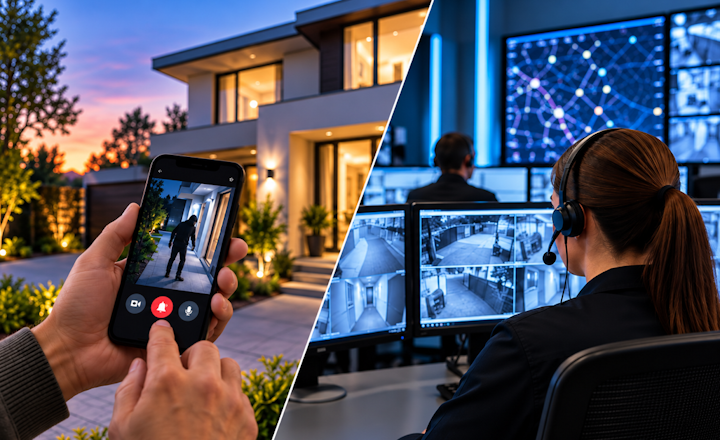
Protecting your home or business is about more than simply installing a security alarm. It's also about what happens when that alarm is triggered.
Modern security systems offer several ways to monitor your property, from smartphone notifications that alert you to suspicious activity to professional alarm monitoring services that provide round-the-clock oversight.
But which approach is right for your needs?
Self-monitored and professionally monitored alarm systems both offer valuable security benefits. However, they differ significantly in how alerts are handled, who takes responsibility for responding and the level of protection they provide when you're unavailable.
In this guide, we'll explore the differences between self-monitored and professionally monitored alarm systems, including their advantages, limitations and suitability for Australian households and businesses.
What Is a Self-Monitored Alarm System?
A self-monitored alarm system allows you to manage your property's security through a smartphone, tablet or other connected device.
When an alarm is triggered, the system sends a notification directly to your phone. Depending on the equipment installed, you may also receive alerts about movement, doors opening, glass breaking or other suspicious activity.
Many modern systems also allow you to view live CCTV footage, receive images from motion detectors and remotely arm or disarm your alarm.
For example, if someone attempts to enter your home while you're at work, your security system could immediately send a notification to your smartphone. You can then check the alert and decide whether further action is required.
However, the responsibility for responding to the alarm remains with you or another nominated person.
If you're asleep, travelling, working or unable to access your phone, an important notification could go unnoticed.
Advantages of Self-Monitored Alarm Systems
Self-monitoring offers several benefits, particularly for homeowners and small businesses looking for greater control over their security.
1. Lower ongoing costs
Self-monitored systems can be more affordable because they don't necessarily require a monthly professional monitoring subscription.
Although some systems charge for cloud storage, mobile connectivity or additional features, basic smartphone notifications may be included with the equipment.
2. Direct control over your security
You can receive notifications, check your system's status and manage certain security functions directly from your smartphone.
This makes it easier to stay informed about activity at your property, wherever you are.
3. Access to live security footage
When integrated with compatible CCTV cameras, a self-monitored alarm can allow you to check what's happening at your property immediately after receiving an alert.
This may help you distinguish between suspicious activity and an accidental activation.
4. Flexibility and convenience
Self-monitoring can suit people who are comfortable managing their own security and who are generally available to respond to notifications.
It also allows users to customise alerts and control compatible smart security devices remotely.
Limitations of Self-Monitored Alarm Systems
Despite these benefits, self-monitoring has one important limitation: it depends on someone noticing the alert and taking appropriate action.
A smartphone notification doesn't guarantee that an incident will be addressed.
Potential limitations include:
Missed notifications: Alerts may go unnoticed when your phone is on silent, switched off or out of battery.
Limited availability: You may be unable to respond while driving, sleeping, working or travelling.
Connectivity problems: Internet or mobile network outages may prevent alerts from reaching your device.
Delayed responses: Even if you receive an alert, you may not be able to arrange assistance immediately.
Personal responsibility: You must decide how to respond, who to contact and whether emergency assistance is required.
For example, imagine receiving an alarm notification at 3 am while you're overseas. You may be able to view the alert, but arranging someone to investigate your property could be difficult.
Self-monitoring provides valuable information, but it doesn't automatically provide someone who can act on that information.
What Is a Professionally Monitored Alarm System?
A professionally monitored alarm system connects your property's security equipment to a dedicated monitoring centre.
Unlike self-monitoring, where notifications are sent directly to your smartphone, a professionally monitored system sends alarm signals to trained operators who can assess the situation and arrange an appropriate response.
This service is commonly known as back-to-base alarm monitoring.
Professional monitoring centres operate 24 hours a day, seven days a week, providing oversight even when property owners are unavailable.
When an alarm is activated, the monitoring team can follow an agreed response procedure, which may include contacting the property owner, checking available security footage or arranging assistance from a security patrol.
The exact response depends on the monitoring provider, equipment installed and agreed instructions.
How Does Professional Alarm Monitoring Work?
Although procedures vary between providers, a typical monitored alarm activation follows these steps:
- An alarm is triggered: A motion detector, door sensor or another connected security device detects activity.
- A signal reaches the monitoring centre: The system transmits an alert using its configured communication network.
- The alert is assessed: A trained operator reviews the available information to determine the appropriate response.
- Further action is arranged: Depending on the circumstances and agreed instructions, the operator may contact nominated individuals, arrange a security patrol or notify emergency services where appropriate.
- The incident is recorded: The monitoring centre maintains a record of the alarm event and the actions taken.
For example, if an alarm activates at a commercial property outside business hours, the monitoring centre can assess the event and initiate the agreed response without relying on the business owner noticing a smartphone notification.
Advantages of Professionally Monitored Alarm Systems
1. Round-the-clock monitoring
One of the main advantages of professional monitoring is that your property's security doesn't depend entirely on your personal availability.
Whether you're asleep, at work, on holiday or unable to access your phone, a monitoring team can assess incoming alarm signals.
2. Trained professionals can assess alarm activations
Not every alarm activation indicates a genuine security threat.
Pets, environmental conditions, equipment faults and accidental activations can all trigger security systems.
Professional operators can use the information available to assess an incident and determine the appropriate next steps.
Where compatible CCTV equipment is integrated, video alarm verification may also help establish whether suspicious activity is taking place.
3. A coordinated response to security incidents
With self-monitoring, you must decide what to do after receiving an alert.
Professional monitoring provides an established response procedure, reducing the need for you to manage every alarm activation personally.
Depending on your monitoring agreement, this could involve contacting a nominated keyholder, arranging a security patrol or escalating an incident to the relevant authorities.
4. Greater convenience
Professional monitoring can reduce the disruption caused by security notifications.
Rather than checking every alert yourself, you can rely on trained operators to assess events and contact you when required under your agreed response plan.
This can be particularly useful for busy households, business owners and people who regularly travel.
5. Potential insurance benefits
Some Australian insurers may recognise professionally monitored security systems when assessing property insurance.
Depending on your insurer and policy, this could influence premiums or help satisfy particular security requirements.
However, discounts are not guaranteed, and you should always confirm the requirements of your individual insurance policy.
Limitations of Professionally Monitored Alarm Systems
Although professional monitoring provides additional support, there are several factors to consider.
Ongoing monitoring fees
Professional monitoring generally involves a recurring subscription, in addition to any installation or equipment costs.
The overall cost depends on the provider, monitoring package and additional response services selected.
Possible additional response charges
Security patrol attendance, equipment maintenance and other services may attract additional fees.
It's important to understand exactly what's included in your monitoring agreement.
Dependence on communication systems
Professional monitoring still requires a reliable connection between the alarm system and monitoring centre.
Systems with suitable backup power and alternative communication paths can help reduce the risk of an interrupted connection, but no system can eliminate every possible failure.
Monitoring doesn't guarantee immediate physical intervention
A monitoring centre can assess an alarm and initiate an appropriate response, but it cannot guarantee that a patrol or emergency service will arrive before an incident occurs.
Physical attendance depends on factors such as location, availability, incident priority and the response arrangements in place.
Self-Monitored vs Professionally Monitored Alarm Systems: Key Differences
The following table summarises the main differences between the two approaches.
Neither approach removes the need for reliable equipment, appropriate installation or regular maintenance.
The fundamental difference is who takes responsibility for assessing and responding to an alarm when something happens.
Self-Monitored vs Professionally Monitored Alarms for Australian Households
For homeowners, the decision often comes down to lifestyle, budget and the level of security required.
A self-monitored system may be sufficient for some households, while others may benefit from the additional reassurance of professional monitoring.
When Might Self-Monitoring Suit a Household?
Consider a homeowner who works from home, rarely travels and has a relatively straightforward security setup.
They may be comfortable receiving smartphone notifications, checking CCTV footage and contacting a nominated person if an alarm activates.
Self-monitoring could also appeal to households looking for an affordable way to improve their security without committing to ongoing professional monitoring fees.
However, homeowners should consider what would happen if they were unable to respond.
For example, would someone be available to investigate an alarm while the family is overseas? What if a notification arrives during the night and everyone is asleep?
These are important considerations when relying entirely on smartphone alerts.
When Might Professional Monitoring Suit a Household?
Professional monitoring can be particularly valuable for households where occupants are frequently away or unable to respond quickly.
This may include families who travel regularly, people who work long or irregular hours, and owners of holiday homes or investment properties.
Imagine a family returning from a two-week holiday to discover that their security alarm had activated several days earlier.
With self-monitoring, the outcome would depend on whether someone received the notification and arranged assistance.
With professional monitoring, the alarm could have been assessed by the monitoring centre when it occurred, with the agreed response initiated if necessary.
This additional oversight can be reassuring when you're unable to keep a close eye on your property.
What About Households with Pets?
Pets can sometimes trigger motion sensors, particularly when detectors are incorrectly positioned or unsuitable for the environment.
With self-monitoring, repeated notifications may become frustrating and could lead to important alerts being overlooked.
Professional monitoring can help manage alarm activations, particularly where compatible video verification is available.
However, neither monitoring method replaces the importance of choosing suitable sensors, installing equipment correctly and maintaining the system.
Self-Monitored vs Professionally Monitored Alarms for Australian Businesses
For businesses, alarm monitoring involves additional considerations.
Commercial premises may contain valuable stock, specialist equipment, confidential information and assets that are essential to daily operations.
An unresolved security incident could also result in business interruption, repair costs and lost revenue.
Consequently, businesses need to consider not only whether their alarm system can detect an intrusion, but also how quickly an appropriate response can be arranged.
Self-Monitoring for Small Businesses
A small business with limited premises and relatively low security risks may consider self-monitoring.
For example, the owner of a small office might receive smartphone notifications when the premises are closed.
They could check available CCTV footage and contact a nominated keyholder if further investigation is required.
This approach may be manageable when there are reliable people available to respond.
However, the responsibility can become increasingly demanding as a business grows.
Business owners may find themselves receiving security notifications during meetings, weekends, holidays and outside normal working hours.
If the owner is unavailable, an important alert could be missed.
Professional Monitoring for Commercial Premises
Professional monitoring provides businesses with an established process for responding to alarm activations.
This can be particularly useful for:
Retail stores containing valuable stock.
Warehouses and distribution centres.
Offices containing expensive equipment or confidential information.
Industrial premises with specialist machinery.
Businesses operating across multiple locations.
Commercial properties left unattended overnight.
For example, imagine a warehouse alarm activating at 2 am.
With self-monitoring, the warehouse manager may receive a smartphone notification. If they don't notice it, there may be no further action until someone arrives the following morning.
With professional monitoring, an operator can assess the activation and initiate the agreed response, which may include contacting a keyholder or arranging security patrol attendance.
This reduces the business's dependence on a single individual being available at all times.
The Importance of Alarm Monitoring for Business Continuity
Commercial security isn't limited to preventing theft.
Some businesses also need to monitor environmental conditions, equipment failures and other incidents that could interrupt operations.
For example, a refrigeration failure could result in valuable stock being lost if nobody notices the problem.
Similarly, a water leak or equipment fault could cause significant damage if it remains undetected overnight.
Where compatible sensors and monitoring arrangements are installed, these events can generate alerts that allow appropriate action to be initiated.
Professional monitoring can therefore form part of a wider business continuity strategy, helping organisations identify and respond to problems before they develop into more serious incidents.
What About Businesses with Multiple Locations?
Managing security across several properties can create additional challenges.
If every location sends notifications to one manager's smartphone, that person may become responsible for assessing numerous alerts across different sites.
Professional monitoring can provide a more coordinated approach, with agreed procedures for each location.
Businesses can establish who should be contacted, which incidents require escalation and how security patrols should be arranged.
This may be particularly useful for retail chains, property managers and organisations with multiple offices or warehouses.
Can You Combine Self-Monitoring with Professional Alarm Monitoring?
Yes. In fact, the two approaches don't necessarily have to be mutually exclusive.
Many modern security systems allow property owners to retain smartphone access while also benefiting from professional monitoring.
This means you can continue receiving notifications, viewing compatible CCTV footage and controlling your security system remotely, while a monitoring centre provides additional oversight.
Some providers also offer shared monitoring arrangements.
What Is Shared Alarm Monitoring?
Shared monitoring combines elements of self-monitoring and professional monitoring.
Rather than relying entirely on a smartphone or outsourcing every aspect of alarm response, shared monitoring allows users to manage their own security while receiving backup from a professional monitoring centre under an agreed arrangement.
For example, you may receive an alarm notification directly on your smartphone, allowing you to assess the situation yourself. If you're unable to respond, the monitoring centre may be able to take further action according to your monitoring agreement.
This can appeal to homeowners and businesses seeking a balance between personal control, convenience and additional security support.
However, the precise escalation process should be confirmed with the provider, including what happens if an alert is missed or the nominated person cannot be contacted.
How to Choose the Right Alarm Monitoring System
Before deciding between self-monitoring and professional monitoring, consider your property's individual requirements.
Ask yourself the following questions:
1. How often is your property unattended?
If your home or business is regularly left empty overnight or for extended periods, professional monitoring may provide valuable additional oversight.
2. Can you reliably respond to smartphone notifications?
Consider whether you're generally available to assess alerts and arrange assistance, particularly during the night or when travelling.
3. What level of security does your property require?
A small residential property may have different requirements from a warehouse containing valuable stock or a business operating across multiple locations.
4. Do you have reliable backup contacts?
If you're unable to respond to an alarm, is there someone else who can investigate or arrange assistance?
5. What is your budget?
Self-monitoring may offer lower ongoing costs, while professional monitoring involves additional fees in exchange for continuous oversight and an agreed response procedure.
6. Does your insurance policy specify security requirements?
Some insurance policies may require particular alarm systems, monitoring arrangements or response procedures. Always check your individual policy before making a decision.
Final Thoughts: Which Alarm Monitoring System Is Right for You?
Self-monitored and professionally monitored alarm systems both play an important role in protecting Australian homes and businesses.
Self-monitoring provides direct control, smartphone notifications and potentially lower ongoing costs. It can be a practical solution for people who are comfortable managing their own security and have reliable arrangements for responding to alerts.
Professional monitoring provides continuous oversight and an established response process, helping ensure that alarm activations can be assessed even when property owners are unavailable.
For households, the decision often depends on lifestyle, travel habits and the availability of trusted people who can respond to incidents.
For businesses, additional considerations include the value of assets, operational risks, after-hours security and the potential consequences of an unresolved incident.
Shared monitoring can also provide a middle ground, combining smartphone access with professional support under an agreed monitoring arrangement.
Ultimately, the most important question isn't simply whether your alarm system can detect suspicious activity. It's whether someone will be available to take appropriate action when that activity occurs.
Understanding the differences between self-monitoring and professional monitoring will help you choose a security solution that meets your property's needs, your budget and your expectations for alarm response.
| < Prev | Next > |
|---|