
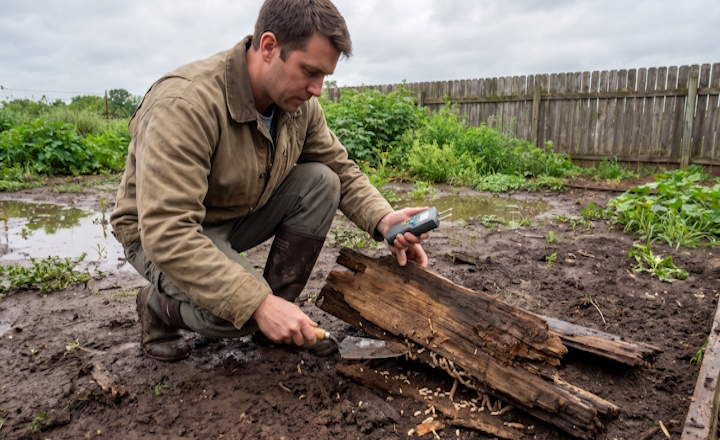
Most pest problems have a seasonal pattern. Mosquitoes peak in summer. Flies increase during warm months. Rodents move inside as temperatures drop in autumn. Termites are less predictable than most pests, but there is one environmental trigger that reliably causes colony activity to increase: sustained soil moisture following heavy rain.
Spring in Sydney brings exactly these conditions. After a dry winter, consecutive days of rainfall in September and October saturate the soil around and under properties, creating the warm, moist subterranean environment that termite colonies need to expand their foraging range.
What Termites Are Actually Doing Underground
Termite colonies spend most of their existence underground or within timber structures. Their workers forage outward from the central colony, constructing mud tubes and tunnels through the soil to reach food sources, primarily structural timber, stored timber, and anything cellulose-based above the soil line.
These foraging tunnels require moisture to maintain. Termites have no protective outer shell that retains moisture the way many other insects do. Dry soil desiccates them. In prolonged dry periods, termite foraging activity pulls back closer to the colony where moisture levels are maintained by the colony itself.
When the soil becomes saturated after heavy rain, that moisture extends far further from the colony than it would in dry conditions. Workers can forage further, faster, and in more directions. A colony that was staying close to a neighbouring tree stump during a dry autumn can reach the subfloor of a house 10 or 15 metres away within weeks of a wet spring.
Why Wet Springs Are a High-Risk Period for Sydney Homes
Sydney's spring rainfall patterns create conditions that suit termite expansion, and the timing coincides with rising temperatures that further accelerate colony activity. Termite workers are most active when soil temperatures are between 25 and 35 degrees Celsius, precisely the range that Sydney's October soil reaches after several weeks of warming.
This is why termite control becomes urgent after heavy rain, and not just during the standard summer pest season. Many homeowners think of termite risk as a summer problem. In practice, the initial expansion that leads to a structural infestation often happens in the weeks following the first significant spring rainfall, well before summer begins.
By the time an infestation is discovered in December or January, the colony may have been in the structure since October, and several months of undisturbed feeding will have occurred.
What Happens to Existing Barriers and Monitoring Systems
Properties that have had professional termite treatment in the past should check the status of their barriers and monitoring stations after a heavy rain period.
Chemical soil barriers can be affected by significant water movement through the soil, particularly in properties with poor drainage or high water tables. A soil drench that was applied two or three years ago and has been subjected to multiple heavy rain events may have reduced effectiveness in sections of the treated zone. This does not mean the barrier has failed entirely, but it is worth having it assessed before another active season begins.
Termite monitoring stations placed around the perimeter of a property work by detecting foraging activity in the bait material. Heavy rain can accelerate the degradation of the bait, and in some cases wash debris into the station housings. A check of all stations after a heavy rain period, both to look for activity and to confirm the stations are intact and functional, is a reasonable precaution.
Early Signs to Look for After a Wet Period
A few weeks after sustained rainfall, it is worth doing a walk around the property and subfloor looking for mud tube formation on external walls, piers, or subfloor timbers. Mud tubes are the clearest above-ground sign of active termite movement.
Other signs include timber that sounds hollow when tapped, paint or plaster that has bubbled or cracked without an obvious moisture cause, and small piles of what looks like fine sawdust near skirting boards or wall junctions. None of these signs are definitive on their own, but any combination of them following a wet spring is worth having a pest technician assess.
Waiting to see whether the signs progress is not a useful strategy. Termites do not slow down once they have found a food source.
Acting Before the Season Is Underway
The best time to have a termite inspection is before active foraging has begun in earnest, not after you have noticed something wrong. In Sydney, that means booking in during September or October, before the soil conditions that accelerate colony expansion are fully established.
Pest Power Sydney carries out termite inspections across Sydney and can assess whether existing barriers and monitoring systems are in good condition heading into the wet season. Getting an inspection done now is a straightforward way to reduce the risk before the conditions that termites need most are fully in place.
Frequently Asked Questions
Does heavy rain damage existing termite barriers?
Significant or sustained rainfall can affect the concentration and distribution of chemical soil barriers, particularly in properties with poor drainage or sloped blocks where water movement through the soil is more pronounced. Barriers applied recently are less likely to be significantly affected than older treatments. A post-rain inspection can confirm whether the barrier remains intact across the full treated zone.
How quickly can termites move into a property after heavy rain?
Colony expansion does not happen overnight, but the process accelerates considerably when soil moisture is high. Foraging workers can extend their tunnel network by several metres in a matter of weeks under favourable conditions. The timeline from increased foraging activity to structural entry depends on how close an existing colony is to the building's foundations.
Should I check my termite monitoring stations after a heavy rain period?
Yes. Monitoring stations rely on bait material that can degrade when exposed to water and debris. After significant rainfall, it is worth checking each station to confirm it is intact, the bait is still present, and there are no signs of foraging activity. If you have a pest management program in place, your technician can do this as part of a scheduled visit.
Are some parts of Sydney at higher risk after heavy rain?
Properties near waterways, in low-lying areas, or with clay-heavy soils that retain moisture for extended periods are at higher risk during and after wet periods. Suburbs along creek lines in the inner west and north shore, as well as properties with large established trees in the garden, tend to see more termite pressure during wet springs.
What are mud tubes and why do they matter?
Mud tubes are narrow tunnels built by termites to travel between their colony and a food source while remaining protected from light and dry air. Finding mud tubes on external walls, subfloor piers, or around pipe penetrations is one of the clearest signs of active termite movement. They should be assessed by a licensed inspector rather than broken open, as disturbing them can cause the colony to retreat and make further detection harder.
Can I treat termites myself after finding mud tubes?
Using over-the-counter sprays on mud tubes is not recommended. Killing the workers visible at the tube does not address the colony, and disturbing the foraging trail can cause the colony to abandon that pathway and find another route into the structure. A licensed pest technician can assess the extent of activity and apply treatment that targets the colony rather than just the workers on the surface.
| Next > |
|---|