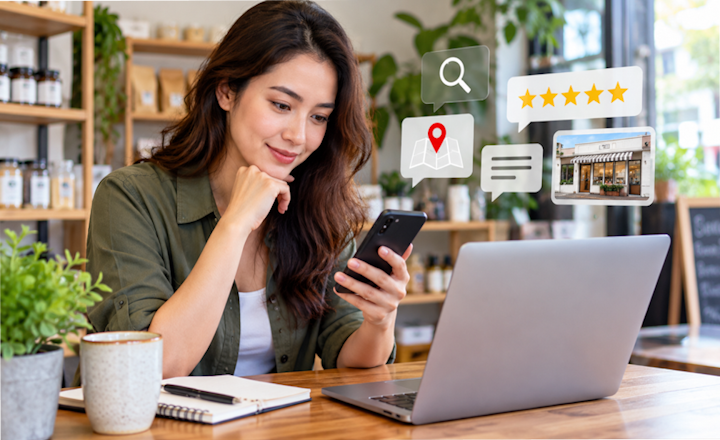
When people need a local service, they rarely begin with a specific business name. More often, the search is broad: “hair salon in Brooklyn,” “dentist near me,” or “birthday cakes in Austin.”
They might start in Google Search, open Maps, browse through Instagram, or jump erratically between all three. Within minutes, several competing businesses end up side by side on a mental shortlist.
That speed matters. BrightLocal’s 2026 Consumer Search Behavior research found that 75% of consumers choose a local business within 30 minutes, and 28% decide in under five. The same research noted that 75% of users rely on more than one channel during their search.
So the question is not just whether your business can be found. It is what a customer actually sees in those crucial first few minutes—and how easy you make it for them to choose you instead of the next tab open on their phone.
Search and Maps Do the First Filtering
Search and Maps are usually where the shortlist begins.
Someone looking for “hair salon in Shoreditch” might compare five nearby salons without knowing a single brand name beforehand. Distance, opening hours, star ratings, categories, and photos all help them narrow the options instantly.
For a business with a physical location, the exact map pin matters more than it seems. It needs to lead to the correct building or entrance, not just "somewhere nearby." Clear, well-lit exterior photos help customers recognize the place immediately when they arrive.
The listing itself must look maintained. Current hours, a working website link, the correct category, and recent photos are basic details, but they directly influence whether the business feels reliable and easy to visit.
Search engines do the first round of ruthless elimination. Make sure your business isn't eliminated simply because of missing information that would have taken five minutes to fix.
Reviews Answer the Questions a Listing Cannot
Star ratings are useful for a quick scan, but written reviews give customers the exact details they need to compare similar options.
A salon customer might look specifically for comments mentioning curly hair or a certain stylist. Someone hiring a contractor cares about punctuality, daily communication, or whether the final bill actually matched the initial quote. A restaurant patron might search the reviews to find out about noise levels, service speed, or a highly recommended dish.
Recency matters deeply here because customers want to know what the experience is like right now, not what it was three years ago. Reviews remain a dominant part of local search: BrightLocal reports that 71% of consumers use Google to read local business reviews in 2026.
How a business replies to these reviews adds valuable context without needing to become a performance. A short, genuine thank-you is enough for a positive review. For criticism, a calm, specific, and professional response is infinitely more useful to future readers than a defensive argument or a generic corporate template.
The Website Should Be Clear Before It Is Clever
Once a business survives the shortlist, customers often open the website to dig deeper. The more useful information available upfront, the better.
A modern small-business website should feel current, clean, easy to scan, and incredibly easy to use on a phone. That last point cannot be overstated: 73% of local searches in BrightLocal’s 2026 research started on a mobile device.
A clear visual hierarchy, readable text, familiar navigation, and obvious booking buttons matter far more than flashy decorative effects. If a business cannot invest in elaborate custom design, a simple, intuitive layout is always better than something creative but confusing.
That doesn't mean the site should look like a relic from 2007. A basic template can feel highly modern if spacing, typography, navigation, and mobile responsiveness are handled well.
But polish cannot compensate for neglect. Outdated prices, expired holiday promotions, broken contact forms, or a booking widget that fails to load will destroy the customer experience immediately.
Make Contact Easy for People Who Do Not Want to Call
A phone number and an email address technically count as contact options. But they are rarely the most convenient ones.
Not everyone wants to call. Some people cannot make or take calls during their workday; others simply prefer written communication. Email works for longer or less urgent questions, but it feels painfully slow when someone wants a quick answer right now.
This friction matters deeply for businesses where decisions can be impulsive. Someone finds a salon they like, sees an opening for tomorrow, and wants to ask one quick question before booking. If the only option is “Leave your number and we’ll call you back,” there is a very high chance they will simply close the tab and open the next salon on their list.
Where it makes operational sense, add fast, written options: WhatsApp, Telegram, Instagram DMs, website chat, or SMS. These should be highly visible, not buried at the very bottom of a secondary contact page.
A business does not need to be active on every single channel. It just needs at least one channel that lets a customer ask a quick question without having to schedule a phone conversation first.
Instagram Shows the Business in the Present Tense
Instagram is incredibly useful because it answers a completely different question: What does this business look like right now?
For salons, restaurants, tattoo artists, photographers, contractors, fitness studios, and other visually driven local businesses, recent work matters just as much as formal business information.
A visitor might check the latest posts, look at tagged customer photos, tap through Highlights, read comments, or check the bio link. They may never actually follow the account—they are simply using it as another data point in their decision process.
The account doesn't need daily viral posts or a massive audience to do its job. Recent work, updated Highlights, a clear bio, and useful replies in the comments are enough to make the profile feel alive and attended to.
Visible engagement can reinforce that impression. Local businesses that want to give an important recent post (like a new service or a promotion) an extra push may use a targeted Instagram likes service to establish a baseline of activity. The role of this service is simple: it supports the visible social activity around a post, but it never replaces the vital, practical information a customer still needs in order to choose the business.
The Easier Option Often Wins
Customers do not move neatly through Search, Maps, websites, reviews, and social media in a straight, logical line. They jump erratically between them.
That means small obstacles add up very quickly. A wrong map pin, unclear mobile navigation, a hidden contact method, or a callback-only form may seem like minor inconveniences on their own. But when a customer has several similar businesses open on their phone at the exact same time, each extra step gives them a perfectly good reason to try another one.
The goal is not to create a flawless, award-winning digital presence. The goal is to make the path from “I need this service” to “I’ve booked it” as short, clear, and frictionless as possible.